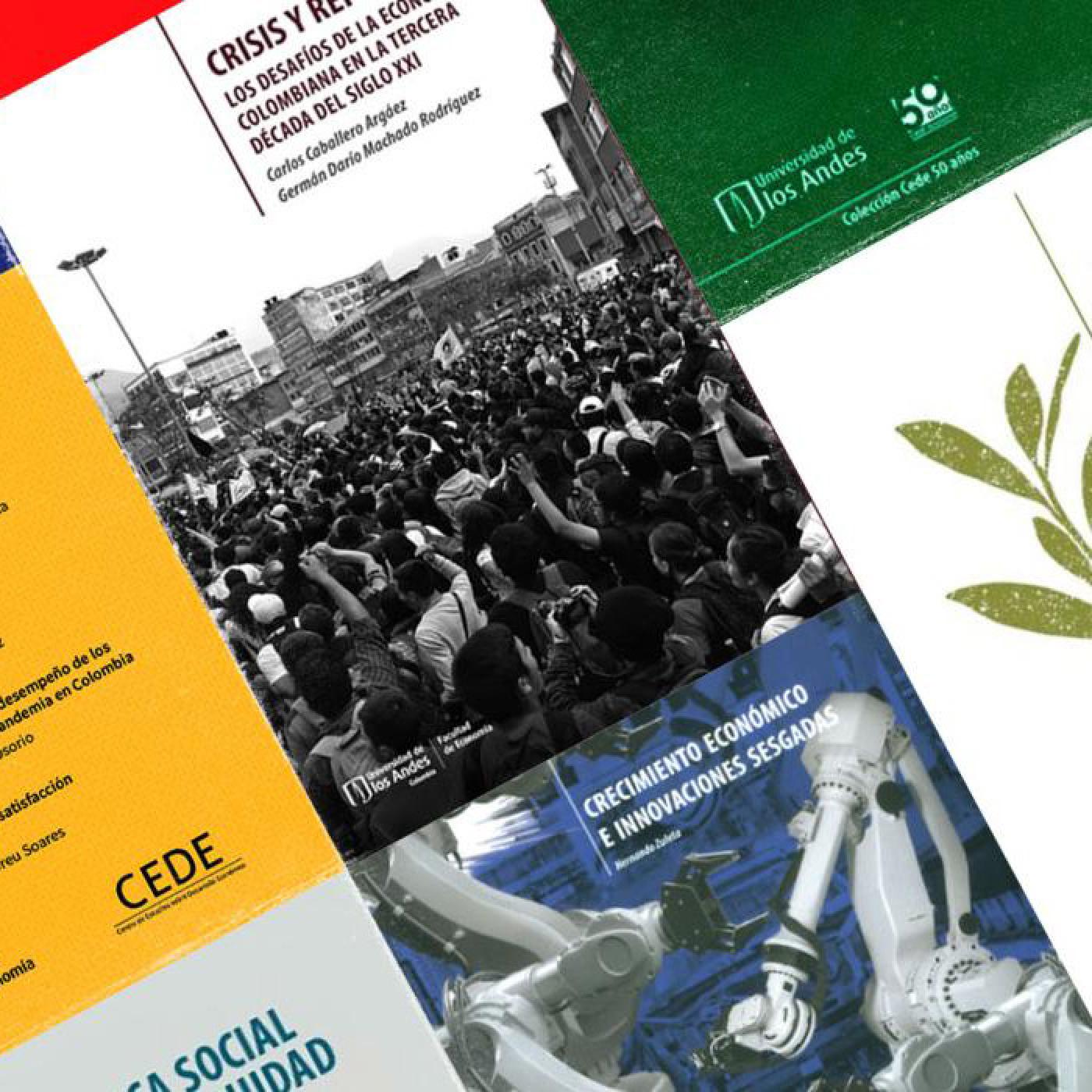
Documentos CEDE
Accede a las publicaciones que reúnen trabajos de profesores/as e investigadores/as de la Facultad de Economía, basados en información del Centro de Datos CEDE. Presentan análisis económicos y resultados preliminares que aportan evidencia y abren discusiones académicas sobre temas relevantes para el país.

Documento CEDE 2023-20
JEL: C34, C36, E51, E52, G23, G41
This paper analyzes the effect of monetary policy decisions (measured through the effective federal funds rate - EFFR -) over the default rate in the peer-to-peer (P2P) loan market in a period of time characterized by an expansionary monetary policy with nominal rates close to zero (2010 - 2018). Using a Heckman-type selection model, and incorporating an additional stage, we model the individual probability that each debtor defaults taking into account the credit allocation decision. The results suggest that in the P2P credit market, a decrease in the monetary policy rate of one percentage point affects the loan market significantly from the fifth month of the policy onwards. This effect lasts five months and disappears by the tenth month after the policy is enacted. At the peak (ninth month) the effect on default is close to 3.1%. Moreover, the effect is found to be increasing according to the risk category of each loan. This paper contributes to the risk-taking channel literature by (i) providing evidence on the existence, magnitude, direction and duration of this transmission channel in the P2P loan market and by (ii) incorporating a tiered analysis of the effect by risk level. In addition, it contributes to the literature that analyzes monetary policy transmission in unconventional ways and to the literature related to credit risk models, by sophisticating the analysis with the implementation of multi-stage models, correcting potential endogeneity problems.
20-08-2023
Documento CEDE 2023-19
JEL: D74, I38, J15, O18, R23
Las reparaciones colectivas son intervenciones de justicia transicional para comunidades afectadas por el conflicto armado. Existe evidencia de que las reparaciones colectivas adelantadas en Perú entre 2007 y 2017, que consistieron en proyectos productivos y de infraestructura, incentivaron la migración interna, pese a lo cual se desconocen los canales que mediaron este efecto. En este estudio se identificaron algunos de estos mecanismos mediante el uso de la metodología de análisis de mediación en el marco de una Regresión Discontinua. Los resultados muestran que los centros poblados beneficiarios de reparaciones colectivas experimentaron una mayor conectividad a internet a nivel de los hogares, lo cual aumentó la migración. A la vez, los centros poblados intervenidos experimentaron un mayor número de beneficiarios de transferencias monetarias en los hogares, lo cual desincentivó la migración. No se encontró evidencia de que el empleo mediara este efecto. Adicionalmente, se encontró que el impacto de las reparaciones sobre la migración fue mayor para los centros poblados más remotos o alejados de las capitales, por lo que las reparaciones significaron el relajamiento de los costos de transacción de migrar asociados a la distancia, falta de información y la lejanía de estas comunidades.
19-08-2023
Documento CEDE 2023-18
JEL: P00, H19, D70, D74
We propose a framework to explain why some societies may end up with different constitutional solutions to the problem of maintaining order in the face of self-interested behavior. Though the salient intellectual tradition since Hobbes has focused on how institutional design is used to eradicate violence, our framework illustrates that equilibrium constitutions may in fact have to deliberately allow for violence. This arises because some societies are unable to use institutions to influence income distribution. In this case, a constitutional tolerance of violence emerges as a credible way for an incumbent to meet the participation constraint of a challenger. We illustrate the results with the comparative constitutional history of the US and Colombia.
18-08-2023
Documento CEDE 2023-17
JEL: D70, D74
Since the end of the Cold War, international third parties such as the United Nations (UN) have become frequent guarantors of peace agreements. Existing studies document that third parties provide assurances that help maintain peace, yet these studies nearly exclusively marshal evidence at the macro-level and focus on elites rather than foot soldiers. Also, their focus is often on the immediate aftermath of war, rather than how third parties affect agreement implementation. Using a novel phone survey of 4,435 ex-combatants from the FARC-EP, Colombia¿s largest rebel group, and an embedded survey experiment, we examine the role of third parties in providing guarantees to foot soldiers during the implementation of the Colombian peace agreement, five years after its signing. We find no evidence that the UN Verification Mission in Colombia increased: confidence among ex-combatants that the government would fulfill its commitment to implement the peace agreement, confidence that the FARC would do the same, perceptions of physical safety, positive perceptions of ex-combatants¿ future economic prospects, nor trust in institutions more generally. We discuss possible explanations for these null findings and the study¿s relevance to debates about conflict termination, peace agreement implementation, and international intervention.
17-08-2023
Documento CEDE 2023-16
JEL: I11, I18, H21, K32, K4
Our study evaluates the liquidation effect of a health insurer from a subsidized regime, with the largest number of affiliates in Colombia, on restrictions to future access to user care. Based on the information regarding complaints and judicial claims (tutelas) about healthcare between 2013-2017 and 2010-2016 respectively, the effect of this government decision is estimated using a dynamic econometric model of differences in differences. Our results suggest that the liquidation of the Health Promoting Entity (EPS in Spanish) CAPRECOM has a negative effect, specifically, it led to an increase of 0.32 and 0.21 in complaints rates per 1,000 affiliates in the receiving EPS during the first and second quarters after the intervention, respectively. This increase represents 76% of the average behavior observed in the control group. However, this effect does not persist over time and becomes diluted in the following quarters. Our results demonstrate the necessity of implementing actions to incorpórate guidelines and strategic plans during the transition period. Such actions would enable safeguarding the right to health for the affected population in a liquidation insurer case.
16-06-2023
Documento CEDE 2023-15
JEL: L71, E22, H68, H72
The mining and energy sector in Colombia is an important source of economic growth, foreign currency, and tax revenue. In late 2022, the government approved a tax reform, the main
collection of the bill comes from the extractive sector. Additionally, members of the government have suggested to stop signing new oil exploration contracts, whilst honoring those already signed. Those policies would decrease investment on the sector, which would have consequences for the future hydrocarbons production. In this paper we analyze the impact that lower investment in the sector would have in fiscal sustainability and macroeconomic stability. The absence of new exploration could significantly reduce the oil revenues of the nation and regions and affect the supply of foreign currency through lower exports and foreign investment. The tax reform would increase the nation's income in the short term, but this increase would not be permanent, and fewer transfers from the sector to the nation would be observed in the medium term, as a result of lower production.
15-05-2023