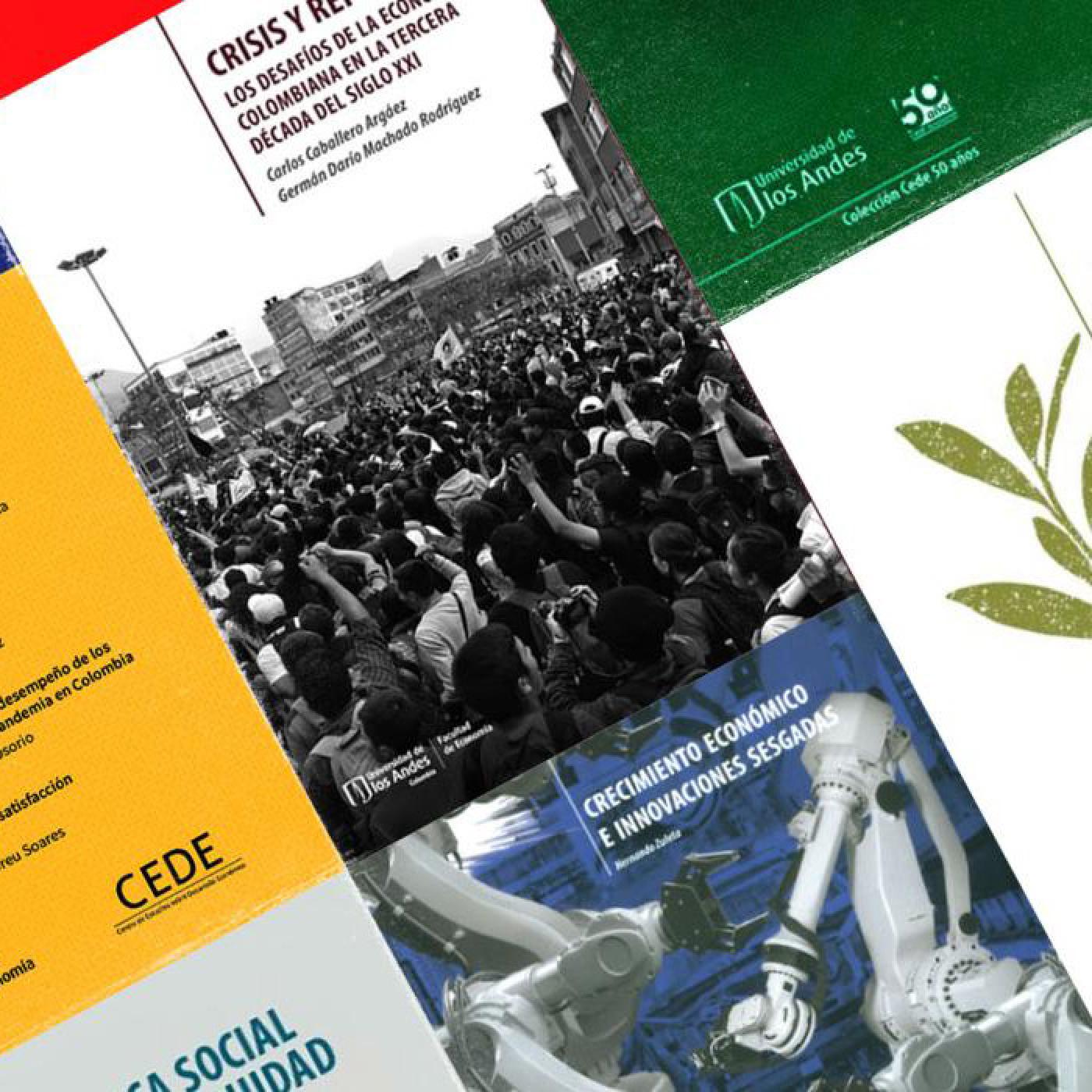
Documentos CEDE
Accede a las publicaciones que reúnen trabajos de profesores/as e investigadores/as de la Facultad de Economía, basados en información del Centro de Datos CEDE. Presentan análisis económicos y resultados preliminares que aportan evidencia y abren discusiones académicas sobre temas relevantes para el país.

Documento CEDE 2024-28
JEL: J31, J38, J46, K31
In this paper, I explore the distributional effects of the minimum wage in the 23 main cities of Colombia during the period from 2008 to 2019. Since the minimum wage is the same throughout the national territory, I use the Kaitz index at the city and industry levels with their actual values, taking the 75th income percentile as a reference to make comparisons based on different levels of minimum wage incidence. I focus on the analysis of private employment and self-employment, separating employed individuals into formal and informal according to pension contributions. I find that increases in the Kaitz index result in a compression effect on the wage distribution for formal private employees, driven by higher wage increases for individuals with incomes closer to the minimum wage. In contrast, for informal private employees, I find that an increase in the Kaitz index reduces labor income, and this effect is more pronounced in the lower income quantiles. For formal self-employment, I do not find distortions in the labor income distribution, whereas for informal self-employment, I find a negative effect. Therefore, my results do not support the existence of a lighthouse effect in Colombia. Finally, I find slight changes in employment compositions, suggesting shifts towards informality, unemployment, and lower labor force participation. Additionally, the number of hours worked increases for informally employed individuals.
28-07-2024
Documento CEDE 2024-27
JEL: C31, C36, D62, O13, O44, Q01, Q15, Q23, Q24, Q56
Colombia is a megadiverse country, hosting over 10% of the planet’s biodiversity, much of which is concentrated in the Amazon biome, covering over 43% of the country’s land surface. Despite its ecological significance, the Amazon region faces threats from deforestation, leading to biodiversity loss and degradation of ecosystem services. The primary drivers of deforestation include socioenvironmental conflicts, such as land conversion, coca cultivation, and illegal mining, all of which are compounded by Colombia’s longstanding internal armed conflict. Additionally, the socioeconomic conditions of the populations settled in the biome significantly influence -and are influenced by these issues. However, there is limited socioeconomic data available, making it challenging to fully understand these relationships. In this document, we define and estimate a set of indicators in four dimensions: i) socioeconomic and demographic information, ii) forest cover, iii) water-related ecosystems, and iv) socio-ecological conflicts, and analyze the connections between indicators and within and between categories and dimensions. The analysis highlights the precarious conditions of the populations in the region, which are worse in the case of indigenous communities. At the same time, municipalities with a greater proportion of indigenous population are associated with higher levels of forest conservation. At a regional level, the northwestern zone remains the most threatened. We discuss how these findings are useful for the conference of the Convention on Biological Diversity.
27-07-2024
Documento CEDE 2024-26
JEL: A12, H41, N56, Q20, Q28, Q33, Q58
REDD+ (Reducing Emissions from Deforestation and Forest Degradation) initiatives are part of the global strategies to reduce greenhouse gas emissions. These projects allow individuals to compensate for their carbon footprint by benefiting vulnerable communities, and retributing them for the conservation activities they carry out. The REDD+ initiatives follow the logic behind Payments for Ecosystem Services (PES), but they are implemented globally, and the presence of third-party agents has blocked their adequate implementation. As part of the REDD+ projects, social and environmental safeguards were designed but they have not been actually fulfilled. Internationally, these projects have faced challenges related to governance, distribution of benefits and effectiveness. In Colombia, similar issues have been identified, such as conflicts around governances, unawareness of the projects from the communities, lucrative interests, among others, that show the difficulties to adequately implement these initiatives. The State support, the improvement of verification measures and the active involvement of communities turn out to be essential criteria for these initiatives to comply with their environmental objectives and to become a viable alternative for benefited communities.
26-07-2024
Documento CEDE 2024-25
JEL: C91, D30, D74, D91, N46
Since formal rules can only partially reduce opportunistic behavior, third-party sanctioning to promote fairness is critical to achieving desirable social outcomes. Social norms may underpin such behavior, but they can also undermine it. We study one such norm —the “don’t be a toad” norm, as it is referred to in Colombia— that tells people to mind their own business and not snitch on others. In a set of fairness games where a third party can punish unfair behavior, but players can invoke the “don’t be a toad” norm, we find that the mere possibility of invoking this norm completely reverses the benefits of third-party sanctioning to achieve fair social outcomes. We establish this is an anti-social norm in a well-defined sense: most players consider it inappropriate, yet they expect the majority will invoke it. To understand this phenomenon we develop an evolutionary model of endogenous social norm transmission and demonstrate that a payoff advantage from adherence to the norm in social dilemmas, combined with sufficient heterogeneity in the disutility of those who view the norm as inappropriate, can generate the apparent paradox of an anti-social norm in the steady-state equilibrium. We provide further evidence that historical exposure to political violence, which increased the ostracization of snitches, raised sensitivity to this norm.
25-07-2024
Documento CEDE 2024-24
JEL: I20, I21, I28, O15
¿Hace una diferencia un refrigerio en el proceso educativo? Este artículo presenta los resultados de la evaluación del Programa de Alimentación Escolar (PAE) de Colombia sobre los resultados educativos. Las estimaciones explotan que la implementación del programa varía en el tiempo entre municipios, escuelas y grados dentro de la misma escuela. El análisis utiliza información de siete años del universo de estudiantes de escuelas públicas y del censo de estudiantes inscritos en educación superior. En comparación con los grados sin PAE, encontramos que la tasa de deserción en los grados con PAE es entre un 10% y un 25% más baja, y la repetición de grado es entre un 7% y un 13% más baja. También encontramos que el PAE aumenta las tasas de finalización de la educación secundaria en un 39%, mejora el rendimiento educativo medido con el examen Saber 11 en 0.1 desviaciones estándar y eleva el acceso a la educación superior en un 20%. El programa se percibe como un incentivo para que los estudiantes asistan a la escuela y un mecanismo para mejorar el proceso de aprendizaje, resultando en un mayor capital humano.
24-06-2024
Documento CEDE 2024-23
JEL: N36, N56, N96, O13
This paper argues that the socioeconomic complexity of native societies determined the dynamics of the conquest and influenced the regional socioeconomic trajectories during the colonial period. While hunter-gatherer societies were rapidly annihilated, agricultural societies with specialized labor negotiated their survival. Based on these stylized facts, three main future trajectories are identified: the imposition of a mining slave system, the expansion of the agricultural frontier, and the establishment of Spanish settlements with indigenous coerced labor. From the initial expeditions of Rodrigo de Bastidas and Gonzalo Jiménez de Quesada to the permanent establishment of settlements, interactions were marked by various contextual factors. In regions with developed political structures, such as the Muiscas, the conquerors adapted institutional systems to exploit native labor. In areas with less hierarchical societies, the exploitation of gold through imported slave labor prevailed. Consequently, these trajectories contributed to developing diverse expressions of the colonial state in the territory that would later become the New Granada.
23-06-2024