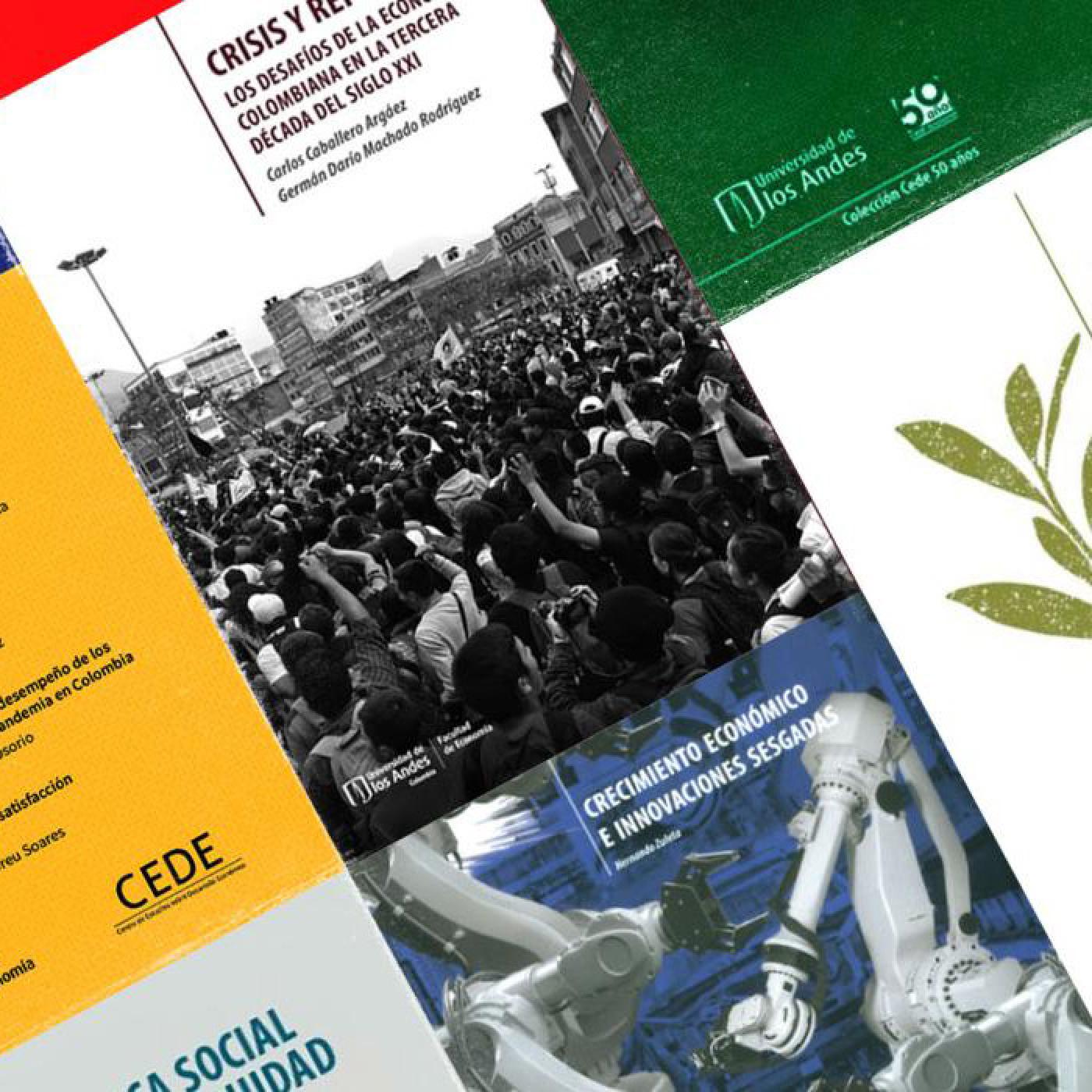
Documentos CEDE
Accede a las publicaciones que reúnen trabajos de profesores/as e investigadores/as de la Facultad de Economía, basados en información del Centro de Datos CEDE. Presentan análisis económicos y resultados preliminares que aportan evidencia y abren discusiones académicas sobre temas relevantes para el país.

Documento CEDE 2024-10
JEL: N36, N96, O10, O43
The Spanish encomienda, a colonial forced-labour institution that lasted three centuries, killed many indigenous people and caused others to flee into nomadism. What were its long-term effects? We digitize a great deal of historical data from the mid-1500s onwards and reconstruct the Spanish conquerors’ route through Colombia using detailed topographical features to calculate their least-cost path. We show that Colombian municipalities with encomiendas in 1560 enjoy better outcomes today across multiple dimensions of development than those without: higher municipal GDP per capita, tax receipts, and educational attainment; lower infant mortality, poverty, and unsatisfied basic needs; larger populations; and superior fiscal performance and bureaucratic efficiency, but also higher inequality. Why? Two mediation exercises using data on local institutions, populations and racial composition in 1794 shows that encomiendas affected development primarily by helping build the local state. Deep historical evidence fleshes out how encomenderos founded local institutions early on in the places they settled. Places lacking encomiendas also lacked local states for 3-4 centuries. Local institutions mobilized public investment in ways that doubtless suited encomenderos, but, over time, spurred greater economic and human development.
10-03-2024
Documento CEDE 2024-09
JEL: D74, I25, J24, K42, O12, O15
In 2008, a powerful Colombian crime lord (Don Berna) was extradited to the United States. Homicides doubled in his stronghold of Medellin immediately following the extradition. We use variation in time generated by the pre- and post-extradition periods, and variation in space generated by areas of Medellin originally controlled by Don Berna to estimate the impact of the extradition on homicides. We then use the extradition as an instrument for homicides, and show that the wave of violence had downstream effects on education outcomes in the city. Homicide exposure led to a decrease in test scores, increased student dropout (driven by males and poorer students), and increased teacher turnover among teachers with the highest qualifications. Homicides disproportionately affect the test scores of high-performing and non-poor students.
09-02-2024
Documento CEDE 2024-08
JEL: J20, J30, J42, L11
We estimate the labor market power of manufacturing firms in 82 low- and middle-income countries using over 13,000 observations from a harmonized global dataset. Wage markdowns— the gap between a worker’s marginal revenue product and their wage—vary widely across countries and show a robust hump-shaped association with the share of self-employed workers. We interpret this pattern using a simple oligopsonistic labor market model with frictions, in which self-employment and wage markdowns are jointly determined, and unemployment protection dictates whether their relationship is positive or negative. Consistent with the model, wage markdowns rise with self-employment in countries with such protection, but fall in those without it. These findings underscore how labor market frictions and regulations shape the link between self-employment and labor market power across countries.
08-02-2024
Documento CEDE 2024-07
JEL: I31, J15, Q53, Q56, R23
Recent research, focused mostly on the United States andWestern Europe, shows that marginalized communities often face greater environmental degradation. However, the ethnoracial categories used in these studies may not fully capture environmental inequality in the Global South. Moving beyond conventional ethnoracial variables, this study presents novel findings exploring the link between skin tone and fine particulate matter (PM2.5) exposure in Colombia. By matching household geolocations from a large-scale longitudinal survey with satellite-based PM2.5 estimates, we find that skin tone predicts both initial pollution exposure levels and their changes over time. Although average exposure levels remained stable during our study period, the environmental justice (EJ) landscape in Colombia contemporaneously underwent a complete transformation. In 2010, lighter-skinned individuals faced higher PM2.5 exposure, but darker-skinned individuals experienced steeper increases in the following years. By 2016, the EJ gap had reversed, with people with the darkest skin tones exposed to PM2.5 levels nearly one standard deviation higher than those faced by people with the lightest skin tones. These patterns remain robust when controlling for a comprehensive set of theoretically relevant covariates, including ethnoracial self-identification and income. Disproportionate exposure to pollution from fires partially explains the observed disparities. Decomposition analysis shows that this variable, local collective action, and economic marginalization account for a sizeable share of the EJ gap. However, one-third of the gap remains unexplained by observable characteristics. With climate change intensifying fire incidence, the disproportionate disease burdens that vulnerable groups face might deepen unless policy measures are taken to reverse this trend.
07-02-2024
Documento CEDE 2024-06
JEL: H51, I18, J17
We review the medico-economic literature assessing the economic value of diagnostic tests. We first present the health technology assessment methods, as applied to generic health interventions. We then define our object of study, diagnostic and prognostic tests, and relate them to various definitions of personalized medicine. We then review the empirical assessments of diagnostic tests related to personalized medicine and of companion tests. We summarize systematic reviews which are not performing quantitative meta-analyses, but rather provide a descriptive synthesis of the results reviewed. We find no evidence that such tests perform better than more traditional approaches, such as pharmaceutical interventions. At the same time, there is a lot of heterogeneity in the cost per QALY (Quality-Adjusted Life Year) gained, so that some genetic testing procedures may perform better than non-genetic ones. Finally, we focus on imperfect tests and show how to optimize, from an economic perspective, their accuracy levels, and how to take accuracy levels into considerations when assessing their economic value.
06-02-2024
Documento CEDE 2024-05
JEL: D72, D78, H40, H50, P00
We investigate how economic inequality can persist in Latin America in the context of radical falls in political inequality in the last decades. Using data from Colombia, we focus on a critical facet of democratization - the entry of new politicians. We show that initial levels of inequality play a significant role in determining the impact of political entry on local institutions, policy, and development outcomes, which can impact future inequality. A vicious circle emerges whereby policies that reduce inequality are less likely to be adopted and implemented in places with relatively high inequality. We present evidence that this is caused both by the capture of new politicians and barriers to institution and state capacity building, and also by the fact that politicians committed to redistribution are less likely to win in relatively unequal places. Our results, therefore, help to reconcile the persistence of economic inequality with the new political context.
05-02-2024