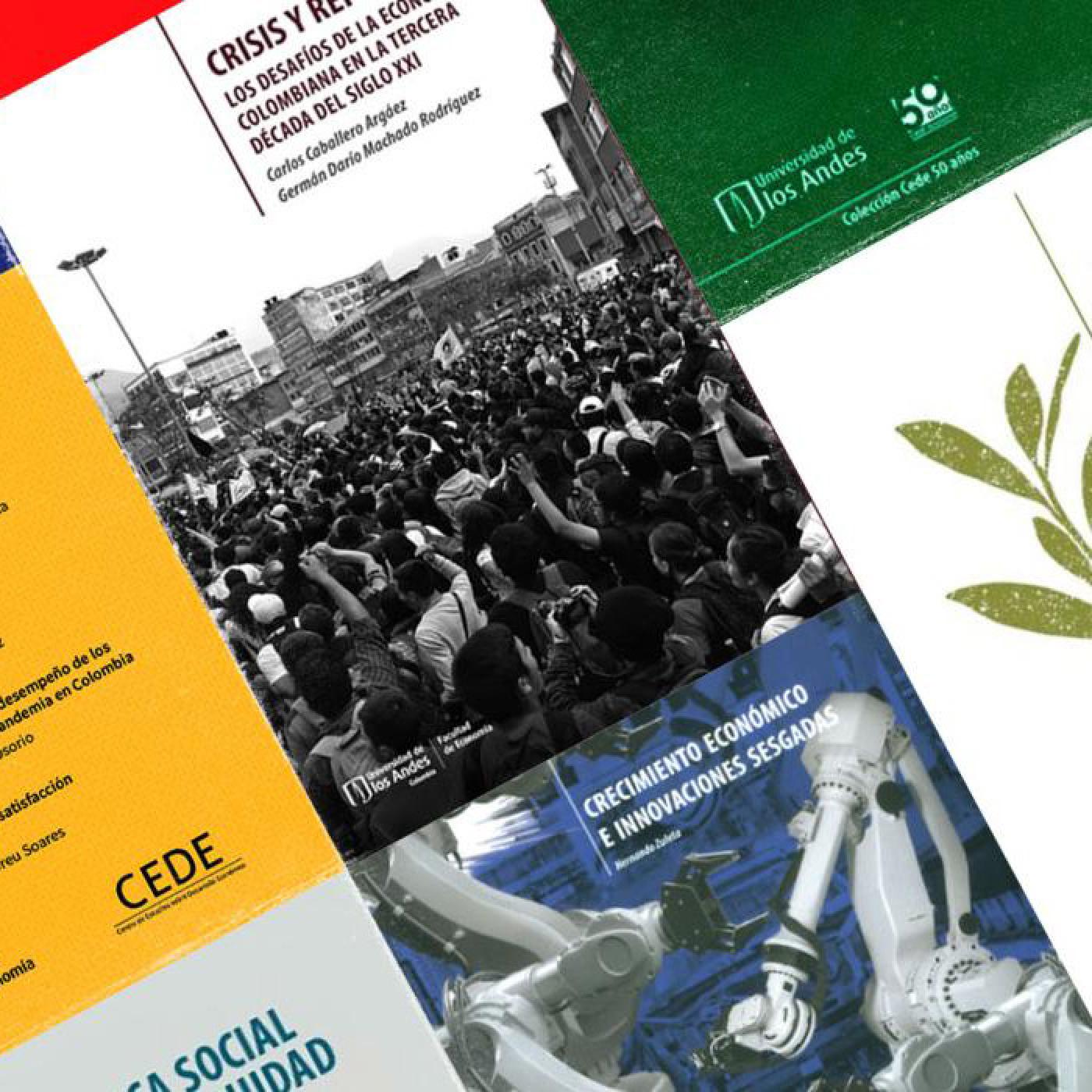
Documentos CEDE
Accede a las publicaciones que reúnen trabajos de profesores/as e investigadores/as de la Facultad de Economía, basados en información del Centro de Datos CEDE. Presentan análisis económicos y resultados preliminares que aportan evidencia y abren discusiones académicas sobre temas relevantes para el país.

Documento CEDE 2023-32
JEL: D73, D78, K14, K42
In this paper we exploit the arguably exogenous staggered implementation of an extensive criminal procedural reform in Colombia between 2005 and 2008 to assess its intended and unintended consequences. The reform had explicit objectives, such as guaranteeing due process protection of the accused, reducing the use of pretrial detention, making the processing of criminal cases more efficient, reducing procedural times, and improving the mechanisms for early termination of criminal processes. Our results show that the reform achieved most of its goals. Namely, a significant reduction in the use of pretrial detention of about 17%-34%; a large and significant reduction in procedural times (18%); an increase in the use of mechanisms for early termination of the criminal process through settlements (43%-66%); and a large and significant increase in the percentage of cases that reach adjudication. Nevertheless, the reform also had negative unintended consequences on arrest, clearance, and crime rates. Our results indicate that arrest rates decreased by about 33% and clearance rates by 16%-27%. The reform also directly affected the incentives for criminal behavior and led to an increase in both property crimes (19%) and violent crimes (17%) as a result of the implementation of the reform. Our paper shows that well-intended reforms aimed at increasing due process protection can create unintended consequences in the administration of justice that led to increases in crime and raises the question of how to balance constitutional protections with public safety by creating special provisions and guidelines directed to mitigate potential adverse effects on crime rates.
22-09-2023
Documento CEDE 2023-31
JEL: O10, O12, O13, N00, D74, Q34
This paper studies the following research question: What are the consequences of historical ethnic conflict on contemporary levels of social capital? This question is relevant, since understanding the consequences of historical ethnic violence on contemporary social capital can provide useful inputs to design effective State-building policies. I exploit Mfecane, a period of ethnic upheaval in South African history, as a setting to examine the causal effects of historical ethnic conflict on contemporary levels of social capital. For this end, I use a combination of a historical approximation of the Mfecane warzone with geocoded data from the Afrobarometer project (2000-2016). Using an instrumental variables strategy, I find that historical ethnic conflict decreases contemporary trust in people among individuals living within the borders of Mfecane, while increasing trust in relatives and neighbors. Increases in in-group trust appear to be driven by the long run persistence of parochial altruism. Conversely, lower levels of betweengroup trust can be explained by the lack of economic incentives to cooperate with strangers in former warzones. These results are suggestive of a degree of substitutability between in-group and between-group social capital, at the community level.
21-09-2023
Documento CEDE 2023-30
JEL: D12, H42, I38, R41, R48
This paper estimates welfare gains using detailed data from a public transport subsidy experiment in Bogota, Colombia. The effective experimental variation in subsidy allocation allows the identification of key parameters in a discrete choice model, resulting in credible estimates of welfare gains for the beneficiaries of the intervention. The program increased participants¿ average monthly welfare, measured as consumer surplus, by $COP48,085 or 3.1% of average monthly household income. Monthly increases in welfare are almost 5 times smaller for commuting for work than for other reasons. Much of the heterogeneity is explained by travel times and less flexibility in commuting times.
20-09-2023
Documento CEDE 2023-29
JEL: C73, K42, O12, O13
In Colombia, since the 90s, one of the main objectives of drug policy has been the reduction of the area dedicated to coca cultivation. Throughout this period, a strategy aimed at this end has been consistently implemented. Initially, it focused on forced eradication, but over the years, voluntary substitution has become more relevant. Despite efforts, this strategy has failed to generate sustained reductions in either the global supply of cocaine or the extent of land under coca cultivation. The central hypothesis that we propose in this paper is that, for a crop substitution process to be successful, it is essential to build a solid bond of trust between the State and the affected communities. We approach this problem from a theoretical perspective, using a model of repeated games that incorporates the effects of the norms of behavior of both communities and government, with a particular emphasis on the element of trust. The main finding of our research is that building trust, through the active participation of citizens in an alternative development program, has the potential to gradually modify the existing balance, generating a substantial reduction in the area cultivated with coca.
19-09-2023
Documento CEDE 2023-28
Distribución de los ingresos y tributación óptima para Colombia, buscando la eficiencia y la equidad
JEL: D63, H21, H24, H26
¿Cuál debería ser la tasa de renta efectiva pagada por las personas naturales en Colombia? Ante esta pregunta se deben tener en cuenta dos aspectos: tanto la necesidad de equidad que tiene el país, como las distorsiones que los impuestos pueden generar (la eficiencia). Siendo la distribución de ingresos uno de los insumos más importantes para dar respuesta a esta pregunta, se ajusta la información entregada por las Encuestas de Hogares, especialmente para las personas de más altos ingresos, con las declaraciones de renta de los colombianos. Luego, teniendo clara la distribución de los ingresos, se prosigue a aplicar el modelo de Mirrlees (1971), modelo estándar para dar respuesta a la pregunta planteada. Este modelo, de manera diferente a los estudios previamente realizados, usa como insumo: una buena suavización de la distribución descrita y diferentes parámetros, como por ejemplo, la elasticidad ingreso-trabajo y las preferencias del Estado, entre otros detallados en esta investigación. Con estos insumos, a través del modelo de Mirrlees llevado a la computación por medio de simulaciones, se arroja una función no lineal que permite detallar cuáles deberían ser los impuestos efectivos pagados por las personas naturales en Colombia. Finalmente, comparando estos resultados obtenidos de las simulaciones con los aplicados actualmente en Colombia, se detalla que la tasa efectiva pagada en este país debería ser más progresiva.
18-09-2023
Documento CEDE 2023-27
JEL: I21, J24, O12, O54
In Colombia, the aerial spraying of coca crops with glyphosate was one of the government¿s main strategies in the fight against drugs and drug trafficking. However, evidence has shown that this program does not reduce coca cultivation, is not cost-effective, and has negative effects on several social and economic variables. This article takes as a case study the quasi-experiment constituted by the suspension of aerial spraying with glyphosate in 2015, and examines its impact on school
dropout rates at the municipal level. Using the difference-in-differences methodology, I find that the ban on this state policy led to a reduction in school dropout rates in municipalities exposed to aerial spraying between 2010 and 2015 relative to other territories. This effect is focused on students in grades one through six and is greater for males than females. These results could be explained by an improvement in the health conditions of people living in municipalities that were sprayed with glyphosate prior to the ban. Nevertheless, this effect is attenuated in areas
with a high probability of registering illicit coca crops.
27-08-2023