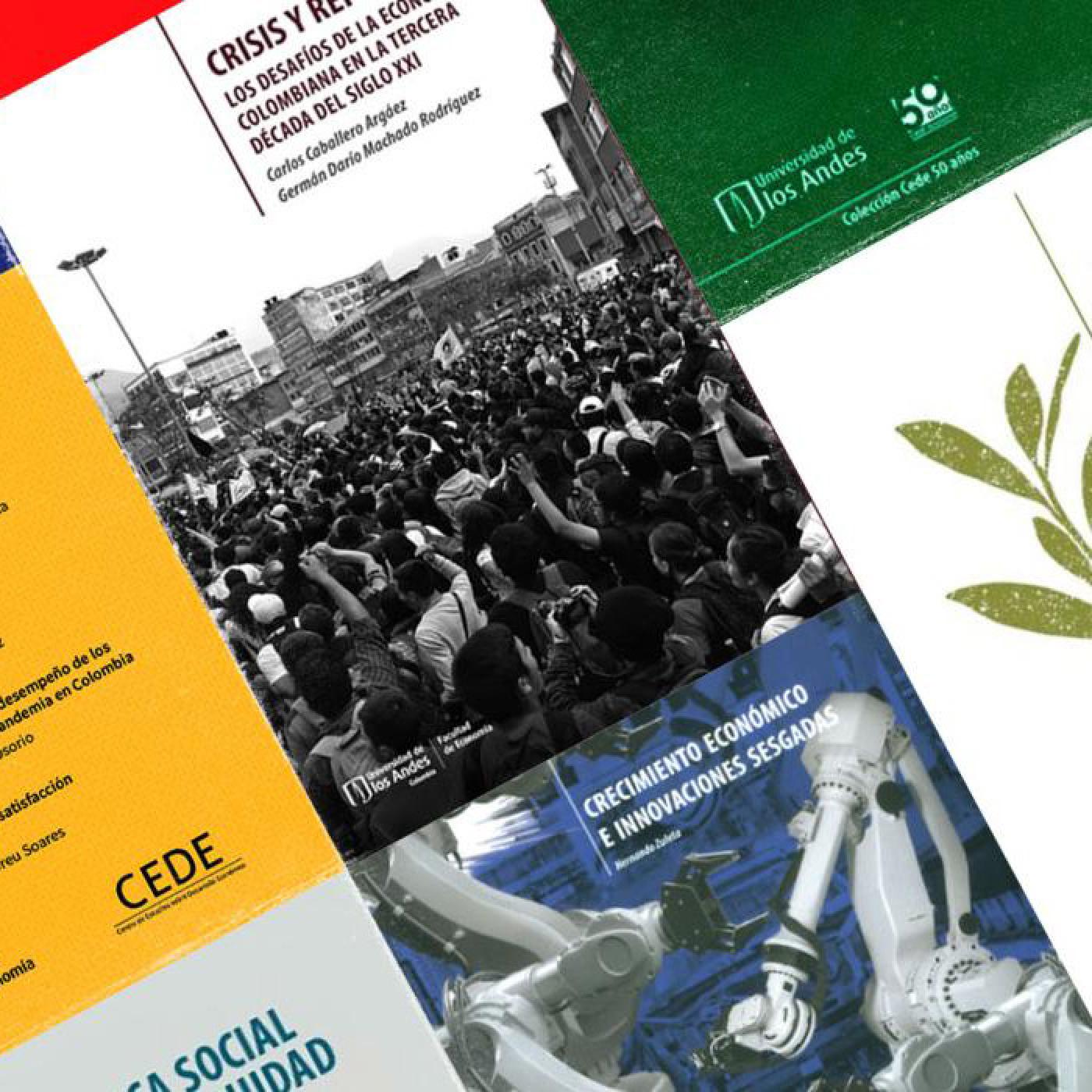
Documentos CEDE
Accede a las publicaciones que reúnen trabajos de profesores/as e investigadores/as de la Facultad de Economía, basados en información del Centro de Datos CEDE. Presentan análisis económicos y resultados preliminares que aportan evidencia y abren discusiones académicas sobre temas relevantes para el país.

Documento CEDE 2024-21
JEL: Q43, C32, O40, E31
The purpose of this research work is to identify the effect and relationships that can occur on inflation, economic growth and the consumption of fossil fuels (gasoline and diesel), through the fuel price stabilization mechanism that Colombia has, the Fuel Price Stabilization Fund (FEPC for its acronym in Spanish). A structural vector autoregressive model (SVAR) is estimated for each fossil fuel using data from March 2010 to August 2023. In particular, throughout this study it will be possible to highlight the positive effect that the implicit subsidy delivered through the FEPC has had on the purchasing power of households and the economic growth of the country and the difference of these effects between the implicit subsidies for gasoline and diesel.simult´aneously, this study endeavors to quantify the impact of this subsidy on fossil fuel consumption, providing a comprehensive analysis of the effects it exerts.
21-05-2024
Documento CEDE 2024-20
JEL: D61, H4, H43
Según la UNESCO (2022), el cambio climático es el desafío más apremiante por el 67% de la población mundial. En Colombia, se calcula que el 78% de las emisiones relacionadas con el cambio climático y la contaminación del aire provienen de los más de 15 millones de vehículos en circulación diaria, incluyendo tractocamiones (Greenpeace, 2022). Esta situación plantea una problemática socioambiental de gran relevancia en términos de políticas públicas, exigiendo la evaluación de diversas alternativas para reducir las principales fuentes de contaminación del aire. El hidrógeno verde emerge como una alternativa al ser un combustible con bajas emisiones. A partir de un análisis costo – beneficio (ACB), este documento presenta la evaluación financiera, económica y social de la implementación del hidrógeno verde como combustible para el caso de estudio de un tractocamión C3S34 que circula en el corredor Bogotá – Barranquilla en tres períodos de tiempo (2025, 2030 y 2035). Los hallazgos sugieren que, en términos financieros, el proyecto apalancado no es viable en el 2025. Sin embargo, en el escenario de 2030 y 2035, el proyecto empieza a ser rentable financieramente, reduciendo cada vez más su brecha con el combustible fósil, e incluso logrando tener un Valor Presente Neto (VPN) más alto en el último período. En términos económicos y sociales, el proyecto resulta viable en los tres escenarios con un Valor Presente Neto Económico (VPNE) positivo que asciende de COP $514 a COP $1.600 millones.
20-05-2024
Documento CEDE 2024-19
JEL: A12, D04, H41, N56, Q01, Q22, Q25, Q26, Q51, Q56, Q57
The Latin America and the Caribbean (LAC) region is particularly rich in biodiversity. With approximately 16% of the Earth’s land surface, it harbors 50% of the planet’s biological diversity. This biodiversity sustains natural ecosystems that provide essential provisioning, regulatory, and cultural services for societal well-being. However, these ecosystems are under threat primarily due to habitat transformation, pollution, climate change, biological invasions, and overexploitation. Additionally, governance systems, economic and technological development, demographic trends, and policy failures exacerbate these pressures. From an economic perspective, these impacts are associated with three market failures: property rights issues, externalities, and information problems. After analyzing these topics in a previous document, this study presents an analysis of the economic value of biodiversity in LAC, considering both national accounting approaches and non-market valuation exercises. Initially, a general valuation analysis is conducted, followed by an examination of the economic value associated with three key sectors related to biodiversity and economic activity in the region: tourism, fishing, and water, all of which depend significantly on ecosystem health. The document concludes with a discussion on the need to incorporate this knowledge into public policies to achieve biodiversity goals.
19-05-2024
Documento CEDE 2024-18
JEL: A12, D04, H41, N56, Q01, Q22, Q25, Q26, Q51, Q56, Q57
The Latin America and Caribbean (LAC) region is exceptionally rich in biodiversity. Covering approximately 16% of the Earth's land surface, it harbors 50% of the planet's biological diversity. Additionally, it is a water-rich region, holding about one-third of the world's potential water resources. This biodiversity sustains natural ecosystems that provide essential provisioning, regulating, and cultural services for societal well-being. However, these ecosystems are under threat primarily due to habitat transformation, pollution, climate change, biological invasions, and overexploitation. Governance systems, economic and technological dewelopment, demographic trends, and policy failures eyacerbate these pressures. Economically, these impacts are associated with three market failures: property rights issues, externalities, and information problems. This document presents a chamcterization Of biodiversity in LAC, highlighting its Current state, importance, and threats. Additionally, it outlines a set of policies that have been designed and implemented to contribute to biodiversity conservation and sustainable use, with an emphasis on three key sectors: tourism, fishing, and water. A second document complements this information with an analysis of the economic value of biodiversity in the region.
18-05-2024
Documento CEDE 2024-17
JEL: C33, D72, D78, E62, H72
Political Budget Cycles (PBCs) refer to spending increases, tax cuts or increases in the deficit that occur before elections, as ruling authorities attempt to manipulate economic variables for lectoral advantages. One factor that can affect the occurrence of PBCs is the existence of fiscal rules. This study aims to investigate whether subnational fiscal rules have mitigated the political budget cycle in Colombian municipalities from 1993 to 2009. Using a database with information from 1034 municipalities, I estimate different dynamic panel models using the Generalized Method of Moments, examining different categories of municipal spending and investment. The evidence suggests the existence of PBCs in the studied fiscal variables, though the cycles have different magnitudes for investment and government spending. Notably, subnational fiscal rules have successfully smoothed the identified cycles, thereby contributing to achieving better public finances at the territorial level.
17-05-2024
Documento CEDE 2024-16
JEL: D11, D60, D62, D70
This article presents a theory of lifetime welfare, considering the corresponding cycles, trend, and span. The model suggests that economic agents should focus more on improving, smoothing, and stabilizing the welfare trend of individuals, than on improving, smoothing, and stabilizing their consumption and income, since they are not the same. Given that private and public decisions can generate internalities and externalities, and thus, inefficiencies, these results can justify individual, social, and government interventions, for example in lifestyle, and the education, health, pension, and insurance markets. It is argued that this approach can be a complement to the worldwide efforts to improve the coverage and sustainability of the health and pension systems; help explain the so-called Easterlin paradox, and contribute to the wellness set point debate in psychology.
16-05-2024