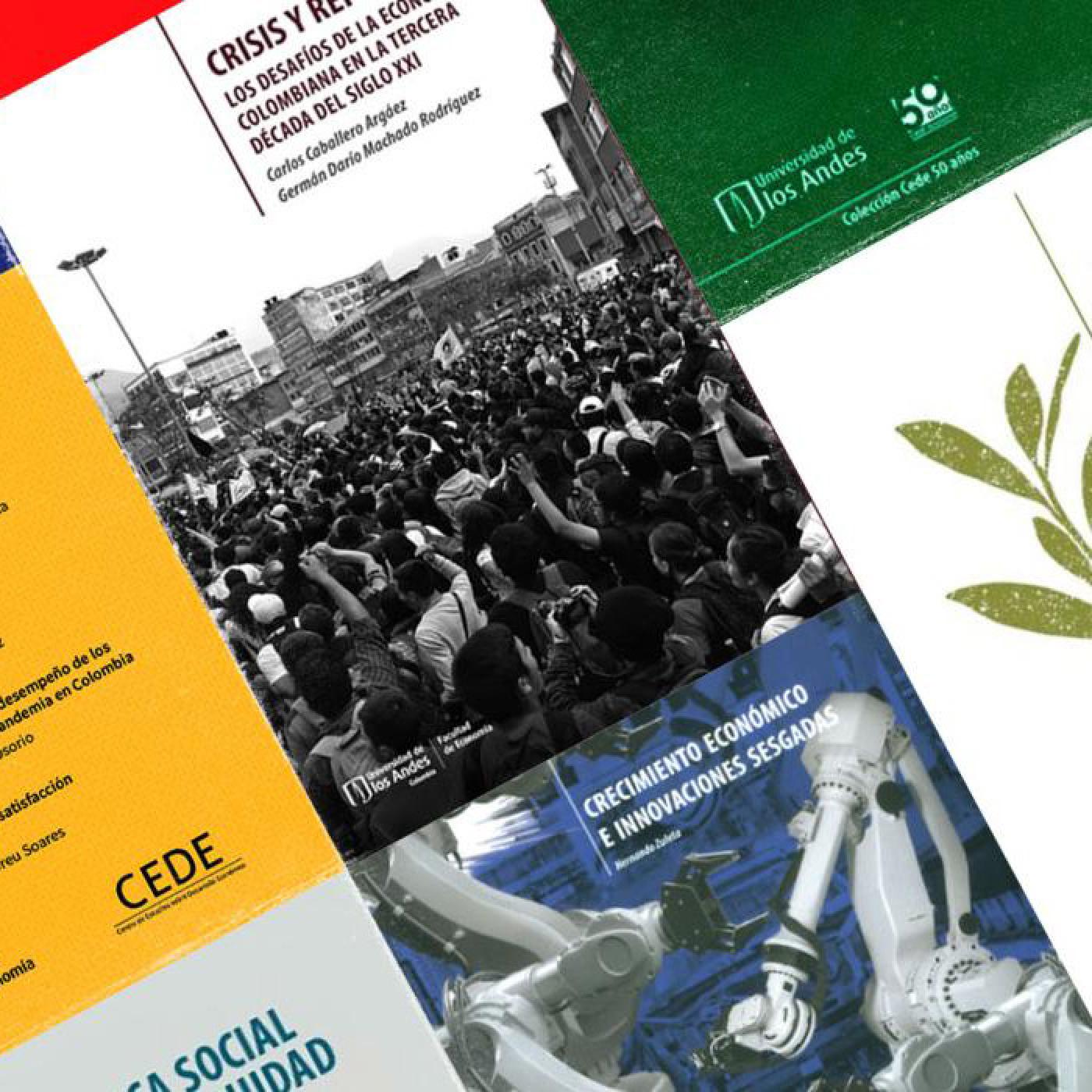
Documentos CEDE
Accede a las publicaciones que reúnen trabajos de profesores/as e investigadores/as de la Facultad de Economía, basados en información del Centro de Datos CEDE. Presentan análisis económicos y resultados preliminares que aportan evidencia y abren discusiones académicas sobre temas relevantes para el país.

Documento CEDE 2022-41
JEL: D73, H11, D80
This paper studies the effects of disclosing information about politician misbehav- ior on trust in public institutions. I use news bulletins from the main anti-corruption agency in Colombia announcing disciplinary prosecutions against municipal mayors. I exploit the timing of the bulletin's publication as a source of variation on the informa- tion about the mayor's misbehavior. Using a difference-in-difference framework, I find that news of the prosecution led to increased trust in judicial institutions. However, the effects on confidence in the political system depend on whether citizens perceive the prosecuted mayor as an individual transgressor or as representative of political in- stitutions that are persistently led by questionable individuals. In the former case, the bulletin's publication increased support for the political system. In the latter, it di- minished trust in the elections, political parties and Congress. These findings highlight the sophistication of citizens' judgements in response to information on institutional performance.
21-10-2022
Documento CEDE 2022-40
JEL: P48, N56, D72
¿Cómo la vigilancia de la validez de los derechos de propiedad afecta la acumulación de tierra por parte de las élites terratenientes? Utilizando una clasificación única de la fuerza de trabajo agrícola municipal y en el marco de un modelo de diferencias en diferencias demuestro cómo los terratenientes, con relación a los campesinos sin tierra, se beneficiaron de una reforma agraria en Colombia al final de la década de 1930 a través de adjudicaciones de grandes terrenos baldíos. Esto se explica por una característica de la reforma: menor vigilancia de la validez de los derechos de propiedad, lo cual redujo los costos de acumular más tierra. Ofrezco evidencia en torno a las inversiones de las élites en poder político de facto que favorecen este empoderamiento: la competencia por recursos en elecciones locales y acción colectiva manifestada a través de asociaciones de terratenientes. Esto en un contexto de tensión entre políticas progresistas bien intencionadas y un proceso de construcción de acción colectiva empujado por los terratenientes en defensa de la propiedad de la tierra, en medio del cual los compromisos en favor de la democratización focalizada de la tierra fueron difícilmente alcanzados. Mis resultados arrojan luces en torno a un posible equilibrio entre la democracia y la alta desigualdad en el cual las élites económicas explotan ciertos rasgos de las instituciones para empoderarse y preservar la certeza sobre sus derechos de propiedad.
20-10-2022
Documento CEDE 2022-39
JEL: D74, D91, F51, O54
More than six years after the signing of the Final Agreement and more than five years after the
beginning of the reincorporation of the FARC-EP, this process continues to be a fundamental challenge for the successful implementation of the Final Agreement and the consolidation of peace. In this working paper, we characterize the attitudes and perceptions of former Farc-EP members in several dimensions at an advanced stage within their reincorporation process. For this, we rely on the results of a novel telephone survey of 4,435 ex-combatants conducted between December 2021 and January 2022 by the research team in collaboration with the Agency for Reincorporation and Normalization (ARN) and the Farc component of the National Council for Reincorporation (CNR). The results of this study reveal some positive aspects regarding the attitudes of individuals in the reincorporation process, but also some that should be considered with special attention and caution. We also analyzed which characteristics of former members of the Farc-EP and their environment are associated with better perceptions in different dimensions such as trust, security, and reconciliation, among others. This analysis was
complemented with information from civilian population, information from the National Reincorporation Registry as of 2019, and administrative data from the ARN. The main objective of this document is to propose public policy recommendations to guide efforts in the dimensions
and people that seem to need them the most.
19-10-2022
Documento CEDE 2022-38
JEL: D74, O10
This chapter describes the trajectories of attention in the reincorporation process of the FARCEP. We analyzed a unique database from the Agency for Reincorporation and Normalization (ARN) with monthly information on interactions and assistance between more than 13,000
former members and reincorporation facilitators (the latter in charge of guaranteeing care and compliance with the benefits established in the reincorporation process). We characterize, on the one hand, the care provided by the ARN to the reincorporated population and, on the other,
the variables associated with a more constant contact with its facilitators. This exercise allows us to study the characteristics and attitudes (measured in the National Reintegration Registry) of the people most likely to actively participate in the process. This chapter contributes to
understanding reincorporation dynamics and trends in assistance and care. Thus, it helps to identify the populations that should receive more attention to strengthen the implementation of the Agreement in Colombia.
18-10-2022
Documento CEDE 2022-37
JEL: H2, H3
Colombia's tax revenues are relatively low, and its tax code runs counter to desirable taxation principles. We document this point in detail in the text and use it as a starting point for proposing road maps to improve the current tax code. This process is not merely a matter of adjusting technical parameters. Instead, it entails addressing the principles that should govern public debate, including legitimacy and the importance of graduality when implementing changes. We propose comprehensive reforms to corporate, personal, environmental and health taxes, among others. The proposed changes would take about 10 years to take full effect, allow for a more progressive, more efficient and fairer tax code and raise more than 3 percent of GDP in additional income.
17-10-2022
Documento CEDE 2022-36
JEL: F51, H56, N4, Q34
Much of the research on conflict resolution has focused on the conditions for getting parties involved in a conflict to sign a peace agreement. Less attention has been paid to what happens next. In this working paper, we offer a review of the available literature on the factors shaping peace agreement implementation (PAI).2 We conceive the implementation process as composed of multiple temporal stages (short to long-term), layers (from international to local), and dimensions (including politics, justice, the economy, and culture). In an implementation phase, all these need to be addressed in parallel, as they exert mutual impact and shape each other¿s progress. The general overview presented here will allow scholars and policymakers to have a broad sense of the most important debates within the literature.
26-09-2022