Pasar al contenido principal

Eventos

En esta sección encontrarás la agenda de eventos académicos, conferencias, seminarios y actividades organizadas por la Facultad de Economía.

Imagen Seminario CEDE - Oskar Nupia
Activo

Seminario CEDE - Oskar Nupia

Oskar Nupia. The literature has highlighted that the socioeconomic characteristics of rulers shape their preferences for redistributive policies and that gaps between citizens and politicians can affect how well public policies address citizens' needs. Yet in many countries, including Colombia, basic information on legislators' economic position remains unavailable. Using a unique dataset built from mandatory disclosure filings, we document the income, wealth, and conflicts of interest (CI) of Colombian legislators during the 2018-2022 and 2022-2026 Congresses. Legislators belong to the top 3% of the income and wealth distribution, earning roughly seven times the median tax filer and holding five times their wealth. On average, 70% of legislators report CI, which span all economic sectors. The largest concentrations of these conflicts are found in Agriculture, Livestock, Real Estate, Commerce, Public Administration, and Personal Services. While reported private economic activities have declined between Congresses, conflicts involving relatives increased by a similar magnitude. Left-wing legislators report lower income and wealth but are not less likely to have CI. Right-wing legislators tend to concentrate their conflicts in Agriculture and Livestock, whereas left-wing legislators focus on Information and Administrative Services. Wealthier legislators report more CI across more sectors, and each additional term in Congress is associated with approximately 15% more wealth. These patterns document a substantial representational distance between legislators and citizens that extends beyond income levels to the nature of economic ties that may shape legislative behavior.


12:30 pm
Salón W-101
Imagen Seminario CEDE - Jonathan Weigel
Activo

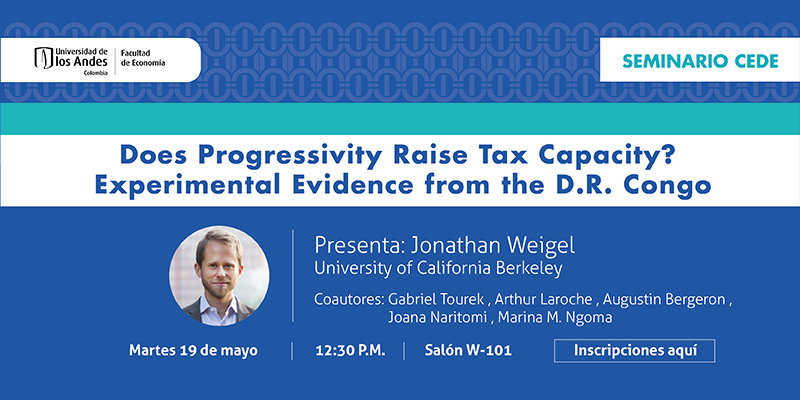
Seminario CEDE - Jonathan Weigel

Progressive taxation is a defining feature of high-income countries' tax systems, but developing countries typically rely on less progressive instruments. We study the introduction of progressive property taxation in a large Congolese city through a citywide field experiment conducted in partnership with the provincial government. Neighborhoods were randomly assigned to either a progressive or a proportional schedule with equal revenue potential. The progressive system increased total revenue by 55\% relative to the proportional one. Revenue gains occurred across the property value distribution: at the top, higher statutory rates mechanically outweighed modest compliance losses, while at the bottom, lower rates induced large compliance gains that more than offset the mechanical revenue loss. Cross-randomized information treatments show that taxpayers' responses were driven by their own rates rather than by others' rates or by the perceived fairness of the overall system. Finally, we examine how statutory progressivity maps into \textit{effective} tax rates (ETRs). Across all systems, ETRs decline with property value --- implying that the rich pay less as a share of wealth --- and this gradient is steepest under the progressive schedule. However, enforcement interventions focused on higher-value properties reverse this relationship, suggesting that investments in targeted enforcement can help align effective with statutory progressivity.

12:30 pm
Universidad de los Andes

Conoce las publicaciones de la Facultad