Pasar al contenido principal

Seminarios CEDE

Con el propósito de fortalecer el pensamiento crítico y difundir avances investigativos, esta propuesta abre un espacio de discusión académica organizados por el Centro de Estudios sobre Desarrollo Económico (CEDE) de la Universidad de los Andes. Abiertos a investigadores/as, estudiantes y público general, estos encuentros promueven el intercambio de ideas en torno a temas clave como el desarrollo económico, la microeconomía, la macroeconomía y la historia económica.


En cada sesión se presentan investigaciones recientes, se discuten avances académicos y se generan debates sobre los desafíos económicos más relevantes para Colombia y el mundo.

Septiembre
24 - John Gómez-Mahecha, Euro-Mediterranean Center on Climate Change - EIEE-RFF


Octubre
8 - Todd Schoellman
22 - Diana Ricciulli
29 - Daniel Mejía, Universidad de los Andes


Noviembre
5 - Ricardo Fonseca
19 - Nolan Pope
26 - Sebastián Montaño
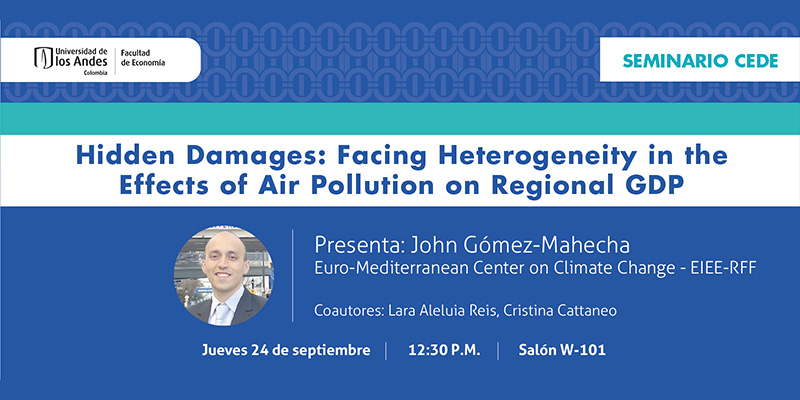

Imagen Seminario CEDE- John Gomez-Mahecha
Activo

Seminario CEDE- John Gomez-Mahecha

John Gómez-Mahecha. Standard estimates of the economic costs of air pollution assume (directly or indirectly) that causal effects and instrument strength are homogeneous across regions. We relax this assumption and show that it matters. Using a panel of European NUTS3 regions from 2000 to 2022, we estimate the effect of PM2.5 on regional GDP per capita through a strategy that jointly accounts for heterogeneity in both the instruments' first stage and the causal response. For the average effect, we implement the Flexible IV (FIV) estimator from the Double-Debiased Machine Learning literature, allowing instrument strength to vary across biogeographical regions. Our preferred estimate is a 0.3 percent decline in GDP per capita per ug/m3 increase in annual PM2.5 - approximately one-third of the reported by conventional two-stage least squares specifications in previous work. Coupling the FIV with an IV Causal Forest yields conditional causal responses that span -1.22 to 0.1 percent, with a long left tail. Statistically significant heterogeneity is driven by regional dependence on agriculture and manufacturing, and by historical exposure to pollution, reflecting the interplay between vulnerability and adaptive capacity. We then allocate the localized damage estimates across income quintiles using microdata from the EU Labor Force Survey and the Survey on Income and Living Conditions. The resulting distributional pattern is non-monotonic: middle-income quintiles bear the largest proportional losses while the top quintile is the least affected.

12:30 pm
Salón W-101
Imagen Seminario CEDE - Oskar Nupia
Activo

Seminario CEDE - Oskar Nupia

Oskar Nupia. The literature has highlighted that the socioeconomic characteristics of rulers shape their preferences for redistributive policies and that gaps between citizens and politicians can affect how well public policies address citizens' needs. Yet in many countries, including Colombia, basic information on legislators' economic position remains unavailable. Using a unique dataset built from mandatory disclosure filings, we document the income, wealth, and conflicts of interest (CI) of Colombian legislators during the 2018-2022 and 2022-2026 Congresses. Legislators belong to the top 3% of the income and wealth distribution, earning roughly seven times the median tax filer and holding five times their wealth. On average, 70% of legislators report CI, which span all economic sectors. The largest concentrations of these conflicts are found in Agriculture, Livestock, Real Estate, Commerce, Public Administration, and Personal Services. While reported private economic activities have declined between Congresses, conflicts involving relatives increased by a similar magnitude. Left-wing legislators report lower income and wealth but are not less likely to have CI. Right-wing legislators tend to concentrate their conflicts in Agriculture and Livestock, whereas left-wing legislators focus on Information and Administrative Services. Wealthier legislators report more CI across more sectors, and each additional term in Congress is associated with approximately 15% more wealth. These patterns document a substantial representational distance between legislators and citizens that extends beyond income levels to the nature of economic ties that may shape legislative behavior.

12:30 pm
Salón W-101

Conoce las publicaciones de la Facultad