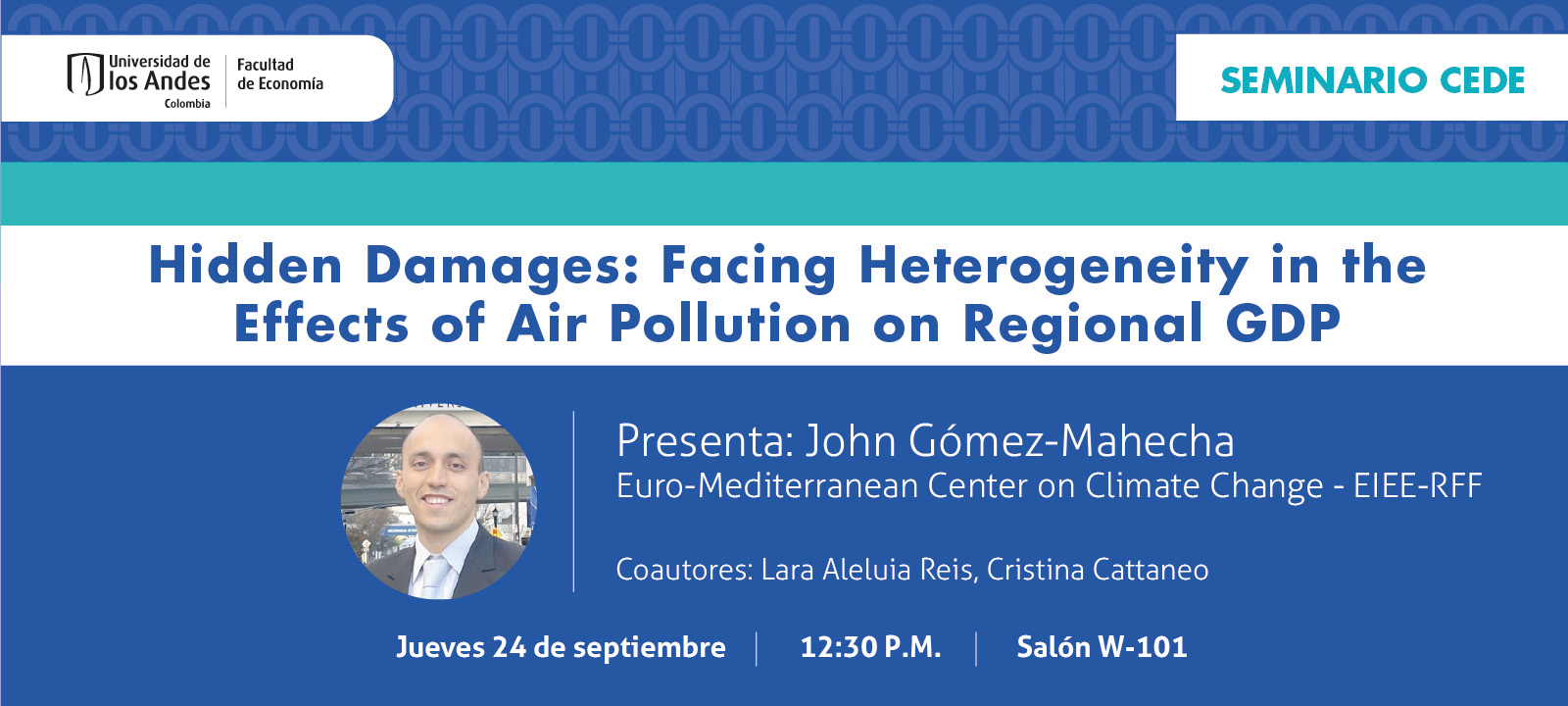
John Gómez-Mahecha.
Standard estimates of the economic costs of air pollution assume (directly or indirectly) that causal effects and instrument strength are homogeneous across regions. We relax this assumption and show that it matters. Using a panel of European NUTS3 regions from 2000 to 2022, we estimate the effect of PM2.5 on regional GDP per capita through a strategy that jointly accounts for heterogeneity in both the instruments' first stage and the causal response. For the average effect, we implement the Flexible IV (FIV) estimator from the Double-Debiased Machine Learning literature, allowing instrument strength to vary across biogeographical regions. Our preferred estimate is a 0.3 percent decline in GDP per capita per ug/m3 increase in annual PM2.5 - approximately one-third of the reported by conventional two-stage least squares specifications in previous work. Coupling the FIV with an IV Causal Forest yields conditional causal responses that span -1.22 to 0.1 percent, with a long left tail. Statistically significant heterogeneity is driven by regional dependence on agriculture and manufacturing, and by historical exposure to pollution, reflecting the interplay between vulnerability and adaptive capacity. We then allocate the localized damage estimates across income quintiles using microdata from the EU Labor Force Survey and the Survey on Income and Living Conditions. The resulting distributional pattern is non-monotonic: middle-income quintiles bear the largest proportional losses while the top quintile is the least affected.