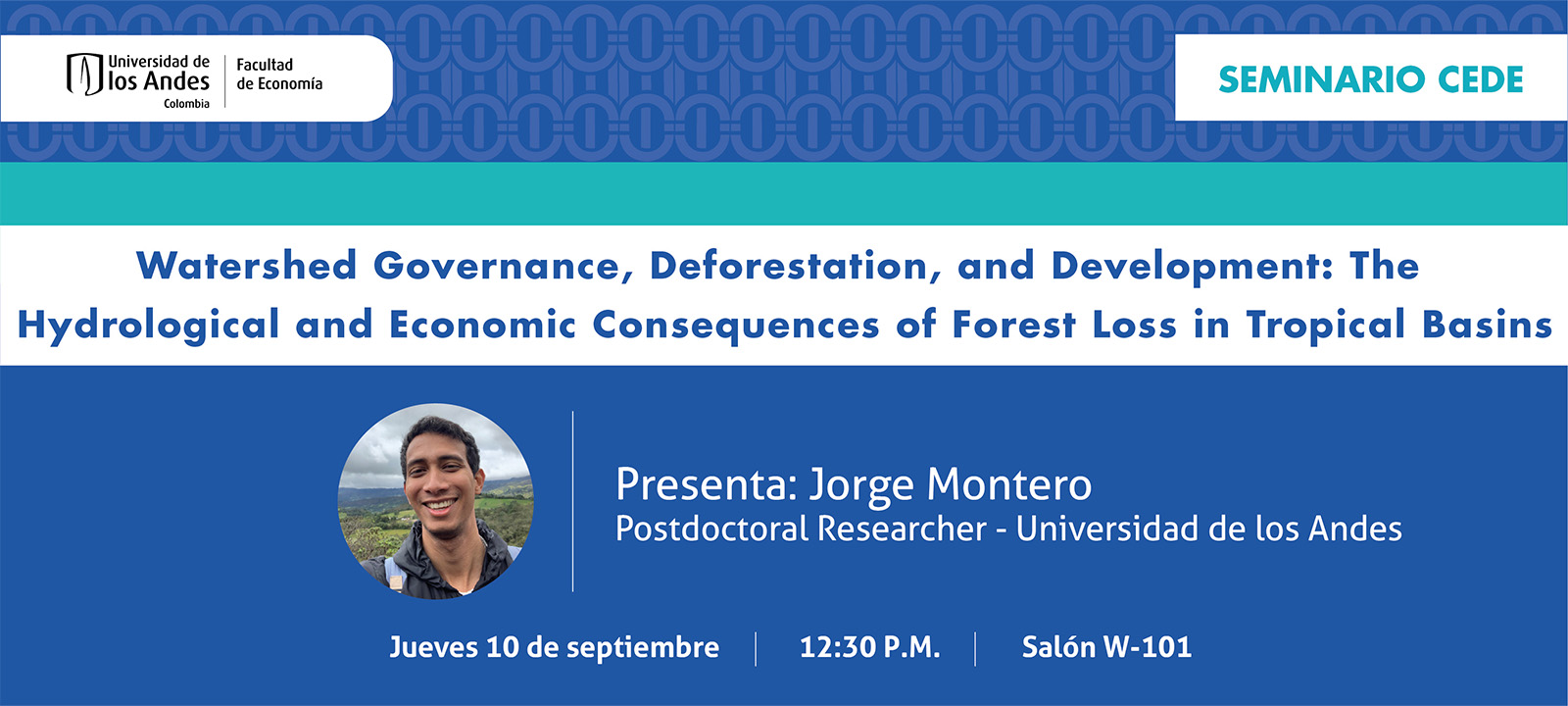
Jorge Montero.
This paper examines how upstream deforestation shapes economic development and climate vulnerability in tropical watersheds. Using a novel grid and municipality-level panel data set for Colombia during 2012–2020, I combine high-resolution hydrological and forest data with municipal socioeconomic, agricultural, disaster, infrastructure, and institutional information. Upstream forest loss is spatially linked to downstream municipalities through hydrological flow networks, allowing me to trace the transmission of environmental shocks across watersheds. The empirical analysis combines two-way fixed-effects models, staggered Difference-in-Differences and event-study designs, and causal forests to identify both average and spatially heterogeneous effects of watershed governance. The results show that upstream deforestation amplifies downstream hydrological risks, significantly increasing exposure to both floods and droughts. This provides evidence that forest loss generates spatially distributed externalities that extend beyond the areas where deforestation occurs. Watershed governance through POMCAs can mitigate these effects by reducing deforestation and attenuating downstream hydrological risks, although its effectiveness varies across watersheds.