Pasar al contenido principal

Eventos

En esta sección encontrarás la agenda de eventos académicos, conferencias, seminarios y actividades organizadas por la Facultad de Economía.

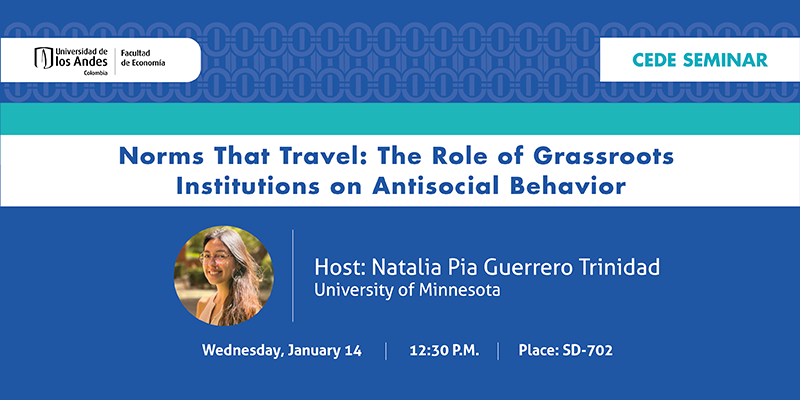
Imagen Seminario CEDE - Natalia Pia Guerrero Trinidad
Activo

Seminario CEDE - Natalia Pia Guerrero Trinidad

In weak-state environments, behavior depends less on formal rules and more on internalized norms, yet how such norms emerge–and whether informal institutions can cultivate them remains unclear. I provide causal evidence that accountable grassroots institutions can form, internalize, and sustain moral norms that shape long-run behavior. My empirical strategy exploits the staggered emergence of Peru’s Peasant Rounds (1976–1983)–community-run security organizations with participatory and accountable design that promoted moral norms– and combines archival, ethnographic, administrative, survey, and original fieldwork data into a new dataset. Using a matched difference-in-differences design across cohorts and birth districts, paired with displacement induced by exogenous weather shocks, I show that exposure to the rounds before age 11 shifts rule-following from fear to empathy, fosters more impartial moral judgments, increases respect for others’ rights, and raises trust beyond the in-group. These changes in moral norms translate into meaningful behavioral outcomes: adult arrests and incarceration fall by roughly 14 percent relative to the control-group mean, and insurgent recruitment declines by about 32 percent. I also find substantial evidence that these norm changes persist when individuals relocate, diffuse into previously unexposed host communities, and extend to the next generation. A placebo comparison with self-defense groups lacking accountability shows no comparable effects. Taken together, the results are consistent with a mechanism in which accountable community institutions socialize children and raise the moral cost of wrongdoing, cultivating intrinsic prosocial motivation that travels with individuals over space and time.


12:30 pm
Universidad de los Andes
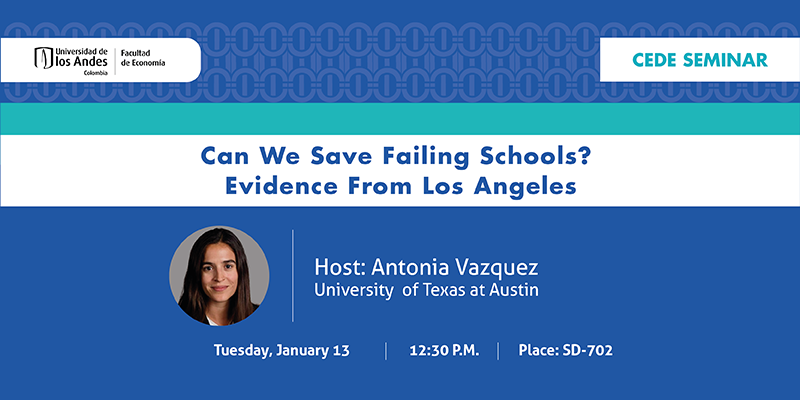
Imagen Seminario CEDE - Antonia Vazquez
Activo

Seminario CEDE - Antonia Vazquez

Can investing in failing schools help them improve? This paper studies this question using a natural experiment based on a 2017 lawsuit settlement that allocated substantial resources to the lowest-performing schools in the Los Angeles Unified School District (LAUSD). Using a difference-in-differences design, I compare 50 secondary schools that received an increase of 13.5% on average in their annual budgets for three years, to nearby public, noncharter schools that received no settlement funding. The intervention mandated hiring of additional staff members and allocating of funds for professional development, but allowed discretionary spending on initiatives for high-need students. I find that, in line with the intent of the settlement, schools hired more personnel, including instructional staff such as teachers and counselors and support personnel such as paraprofessionals and school service staff, all effects statistically significant. Settlement schools achieved a 0.75 percentage points reduction in suspension rate relative to unfunded schools, reflecting a marked improvement in performance outcomes. These reductions were particularly notable given that the settlement triggered demographic sorting, with the treated schools losing students overall and shifting toward higher concentrations of economically disadvantaged students and lower Black enrollment. A simple bounding exercise that accounts for demographic sorting indicates that the settlement had meaningful effects on suspension rates, suggesting real improvements on noncognitive dimensions of schooling. Survey evidence suggests that two key mechanisms for lower suspensions were improvements to school climate as reported by staff and students, and enhancements to educators’ capacity and disciplinary approaches.  

12:30 pm
Universidad de los Andes

Conoce las publicaciones de la Facultad