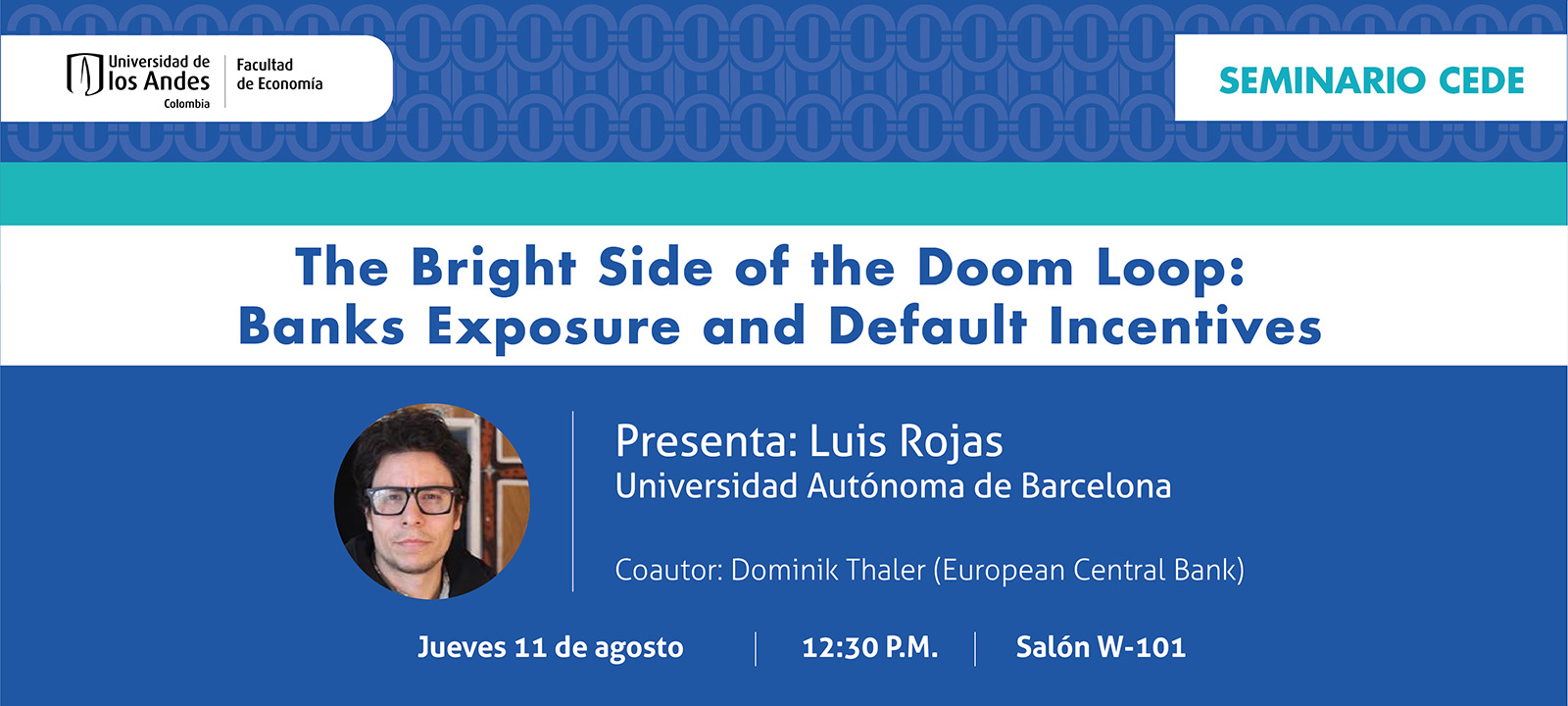
Seminario CEDE - Luis Rojas
Facultad de Economía
Facultad de Economía
The feedback loop between sovereign and financial sector insolvency has been identified as a key driver of the European debt crisis and has motivated an array of policy proposals. We revisit this doom-loop focusing on governments' incentives to default. To this end, we present a simple 3-period model with strategic sovereign default, where debt is held by domestic banks and foreign investors. The government maximizes domestic welfare, and thus the temptation to default increases with externally-held debt. Importantly, the costs of default arise endogenously from the damage that default causes to domestic banks' balance sheets. Internally-held debt thus serves as a commitment device for the government. We show that two prominent policy prescriptions lower exposure of banks to domestic sovereign debt or a commitment not to bailout banks can backfire, since default incentives depend not only on the quantity of debt, but also on who holds it. Conversely, allowing banks to buy additional sovereign debt in times of sovereign distress can avert the doom loop. We also show that the recently proposed anti fragmentation tool of the ECB could also backfire if local banks engage in a selloff of sovereign debt.