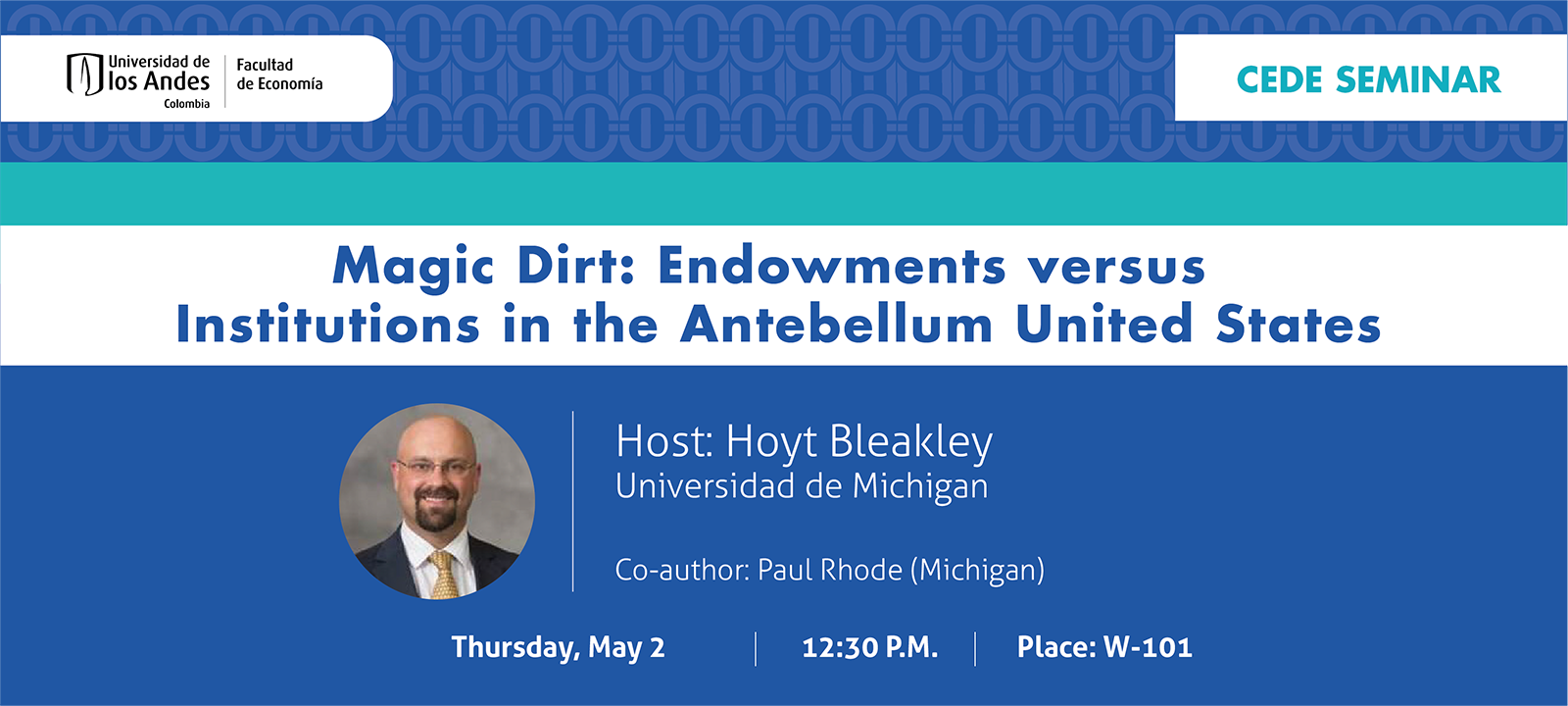
Seminario CEDE - Hoyt Bleakley
Facultad de Economía
Facultad de Economía
In the Antebellum United States, free soil areas had greater economic development than the areas where slavery was legal, yet free farming did not displace slave-based agriculture in the slave states. Was free soil a magic dirt, or could free farms compete in the slavery-legal region? We consider three classes of tests. First, we construct, separately for the two regions, suitability indices using soil and climate endowments. The indices suggest free-soil techniques could have prospered in the Upper South. Second, we show that endowments earning a high (hedonic) return on free soil received little return where slavery was legal. Third, we randomly sample farmers from the 1860 agricultural census in Kentucky and compare them to free farmers in states across the Ohio River. Kentucky farmers without slaves had farms of lower value per acre but produced more output per farm value than either their slaveowning neighbors or farmers in the neighboring free states. Together, this evidence indicates that a free-soil society could have thrived in the border South but prevailing institutions held back free farms.