Pasar al contenido principal

Eventos pasados

Consulta en esta sección los eventos anteriores.

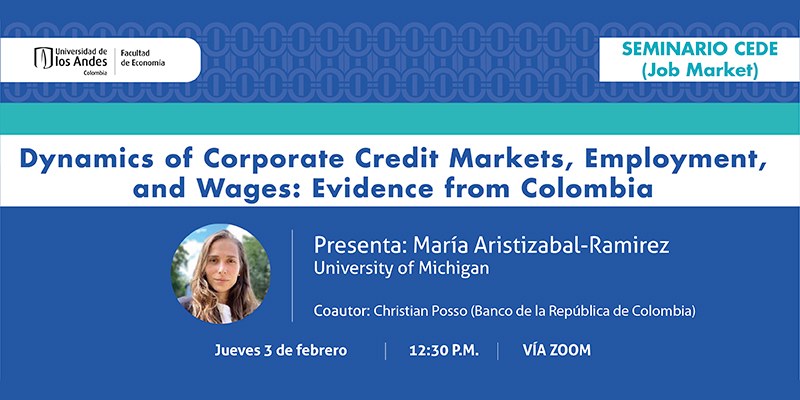
Imagen Seminario CEDE - María Aristizabal-Ramirez
Activo

Seminario CEDE - María Aristizabal-Ramirez

This paper examines the impact of changes in corporate credit supply on employment and wages outside of financial-crisis episodes. We construct a rich annual employee-employer-credit-bank database using Colombian administrative data from the period 2008--2018 and estimate corporate credit-supply shocks using firm and bank fixed effects. These estimates provide new evidence on three empirical facts: In response to a positive credit-supply shock, (i) firms increase their investment but do not change their average employment or wages; (ii) wages decline in the bottom half of the wage distribution while increasing at the top of the distribution; and (iii) firms with more liquid assets increase employment. We develop a small-open-economy model where the effect of a credit-supply shock is consistent with the empirical facts. In the model, two opposing mechanisms are key to explaining the results: capital-low-skill substitutability and firm-specific liquidity constraints to finance labor. These competing forces explain why average wages and employment do not change in response to credit-supply shocks while low-skilled wages decline. We use the model to study how permanent reductions in the banking intermediation premium influence firm-level responses to credit-supply shocks. Relative to the baseline model, we show a positive short-term impact on employment and wages and a negative long-term effect.

12:30 pm
Zoom
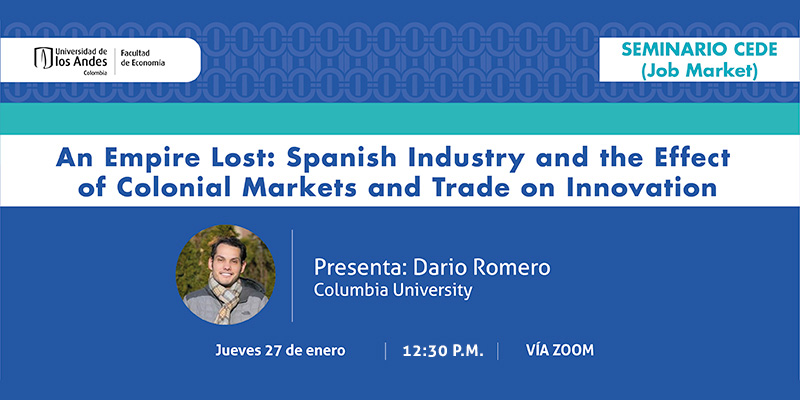
Imagen Seminario CEDE - Dario Romero
Activo

Seminario CEDE - Dario Romero

This paper studies how changes in access to international markets affect the direction of technical change. I use two historical trade shocks that transformed markets for the Spanish textile industry at the end of the 19th century, along with newly digitized data on textile patents and production in Spain. First, after Spain effectively forced its colonies to buy manufactured cotton goods in 1891, I document an increase in cotton textile innovation relative to other fabrics. Second, after the Spanish-American war and the unexpected loss of these captive markets, I find that innovation in cotton textiles changed towards new weaving patents relative to other parts of the cotton textile production process such as threading. After 1898, cotton industrialists entered and competed in international markets where more sophisticated fabrics were in demand. Using novel archive data from a big cotton firm, I provide price and quantity-based evidence of the strength of each type of technical change. Finally, I show that these new incentives to innovation translated directly into adopting new mechanized tools in the sector. I find evidence of an expansion in industrial technology due to an increase in mechanized cotton looms used in Spain after 1900. Together, these results provide some of the first causal evidence on how international trade shapes the direction of the technical change. Although each shock meant access to new markets for Spanish cotton textiles, their effect on innovation varied because the composition of textile demand was different.


12:30 pm
Zoom