Pasar al contenido principal

Eventos pasados

Consulta en esta sección los eventos anteriores.

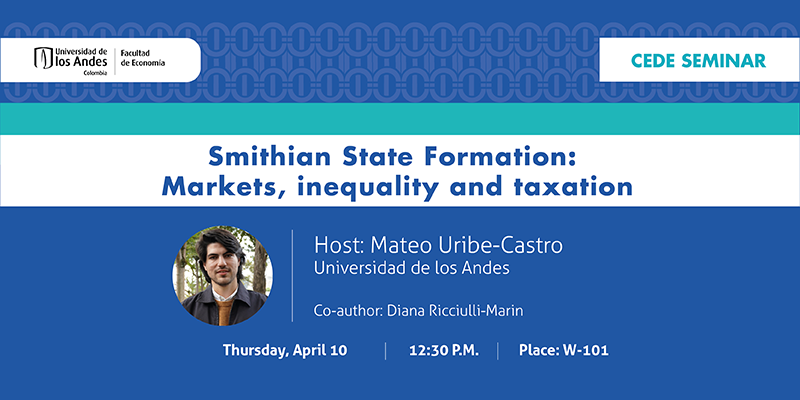
Imagen Seminario CEDE - Mateo Uribe-Castro
Activo

Seminario CEDE - Mateo Uribe-Castro

We study the impact of the Panama Canal on the development of Canada’s manufacturing sector in the years from 1900 to 1939. Using newly digitized county-level data from the Census of Manufactures and a market-access approach, we exploit the plausibly exogenous nature of this historical episode to study how changes in transportation costs influence the location of economic activity and productivity dynamics. Our reduced-form estimates show that lowered shipping costs led to greater market integration of marginally productive Canadian counties with key markets both inside and outside of Canada. This development permitted the reallocation of production activity to places whose production levels had been inefficiently low before the Canal opened. A shift from the 25th to the 75th percentile in terms of gains in market access brought about by the opening of the Canal led to a 9% increase in manufacturing revenues and input expenditures. Productivity rose by 13%. These effects persist when general equilibrium effects are considered: the closure of the Canal in 1939 would have resulted in economic losses equivalent to 1.86% of GDP, chiefly as a result of the restriction of the country’s access to international markets. Altogether, these results suggest that the Canal substantially altered the economic geography of the Western Hemisphere in the first half of the twentieth century.

12:30 pm
Universidad de los Andes - W-101
Imagen Seminario CEDE - Felipe Lozano
Activo

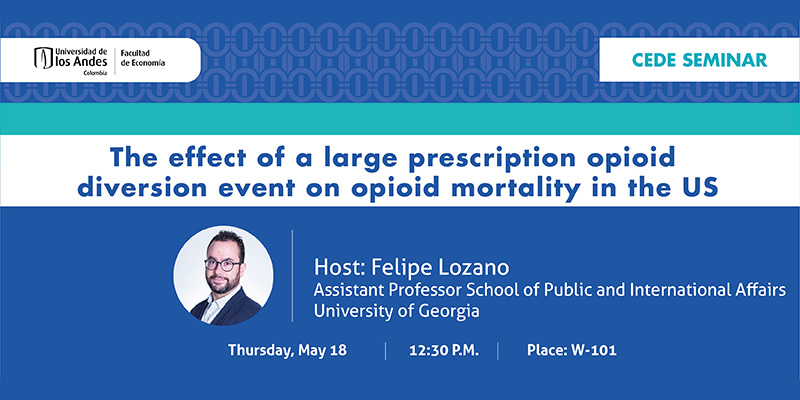
Seminario CEDE - Felipe Lozano

Over a two-week span in December 2007 a massive spike of prescription opioids surged suddenly into retail pharmacies in 78 counties in five Southeastern U.S. states. These “spike counties” experienced an average increase in opioid deliveries of 313\% over baseline, with one Mississippi county experiencing a 1300% increase. The magnitude of this surge was over 3.4 billion morphine milligram equivalent units - more than 147 million standard doses. The pattern of facts available is consistent with the hypothesis that Colombian drug cartels became suddenly unable to launder large amounts of physical cash at the end of 2007 at a time when their capacity to supply eastern US heroin markets was failing and therefore used their excess physical cash to acquire prescription opioid products which could then be diverted to the illicit drug market in the US east of the Mississippi River. Importantly, any relative increase in prescription opioids (manufactured with very tight therapeutic windows) in the illicit market would be expected to displace heroin at least partially (manufactured with varying potency which cannot be known prior to consumption), implying the spike in diversion amounted to an unplanned harm-reduction shock for prior heroin or other non-prescription opioid users. We estimate novel difference-in-differences models of substance-specific opioid mortality, using counties west of the Mississippi River as controls, and the geographic distance to a spike county as the intensity of treatment. We find that in the two years following the shock, there were fewer deaths from heroin and all non-prescription opioid mortality in localities up to 200 miles (driving distance) from spike counties, with benefits becoming generally smaller and statistically insignificant beyond that point. We argue that these reductions can be directly attributed to the diversion and account for 448 lives saved in the spike counties’ vicinity per year, or nearly 30% of heroin deaths in those areas.

12:30 pm
Universidad de los Andes - W-101
Imagen Seminario CEDE - CESED | Benjamin Lessing
Activo

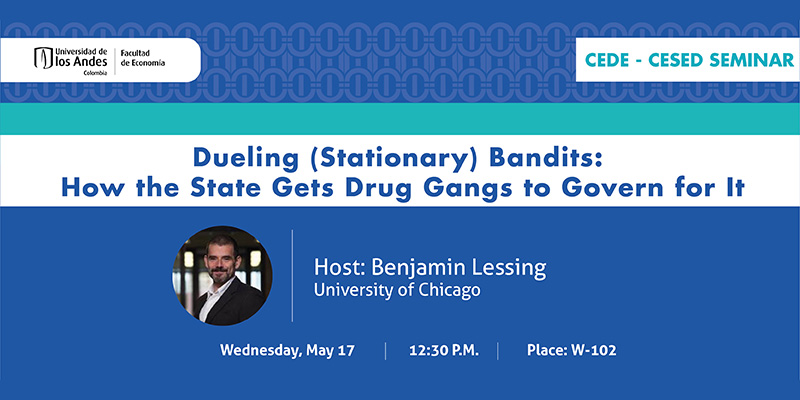
Seminario CEDE - CESED | Benjamin Lessing

If states strive to establish monopolies on the legitimate use of force, why is criminal governance---gang rule---over civilians so common and persistent, especially in urban zones within easy reach of state forces?  How have the resulting “duopolies of violence” survived decades of aggressive policing? Why do drug-retailing gangs often govern without taxing their subjects at all?  ``Market-for-Protection'' models of state formation and that assume competition among symmetric, would-be monopolists provide limited traction on these questions. Instead, I develop a public-goods model where state and criminal governance overlap, and in which each stands to benefit the other actor. I adapt  Mcguire and Olson’s (1996)  model of stationary banditry by including a second bandit---the gang---and, in an extension, a drug market in which gang governance (and taxation) affect drug profits by winning (losing) residents' loyalty. Under some conditions, the state prefers criminal duopoly to Weberian monopoly: if gangs' relative costs of governance are sufficiently low, or if they can draw on illicit drug profits to finance governance. I analyze equilibria in which state repression of trafficking incentivizes gangs to channel drug profits into governance and reduce taxes on residents, indirectly benefiting the state enough that it prefers duopoly. Even if partially offset by the political costs to elected officials of criminal governance, these underlying fiscal benefits help explain the persistence of duopolies of violence over generations.
12:30 pm
Universidad de los Andes - W-102
Imagen Seminario CEDE - Alvaro Sandroni
Activo

Seminario CEDE - Alvaro Sandroni

We ask whether the decisions of a rational and impartial judge can be distinguished from a coin toss. The question is inspired by the logic of the selection effect: Cases that have a clear outcome tend to be settled out of court. But that means that the cases that tend to go to court are often decided by small shocks on perceptions, the equivalent of a coin toss. That conclusion changes when judges are biased in their prior beliefs. In that event, outcomes will be determined exclusively by the judge’s prior beliefs. Either way the outcome of the case tends to be decided as if it is unaffected by the merits of the arguments presented in court. However, taken to its logical conclusion, the selection effect leads to something we refer to as the paradox of open methods: if rational judges decide to evaluate the merits of the cases that go to court, they will come to regret this as wasteful effort and strictly prefer to ignore the merits of the case. But if judges ignore the merits of the case, and this becomes generally known and taken into account by the litigants, judges will come to regret doing so and end up strictly preferring to attend to the merits of cases. This paradoxical seesaw can only be resolved in a full game-theoretical model of strategic interaction between the judge and the litigants. We refer to this game as the Judging Game. The strength of the selection effect and the fraction of judges who evaluate the merits of cases can thus be determined by the equilibrium of the Judging Game. Paper  

12:30 pm
Universidad de los Andes - W-101