Pasar al contenido principal

Eventos pasados

Consulta en esta sección los eventos anteriores.

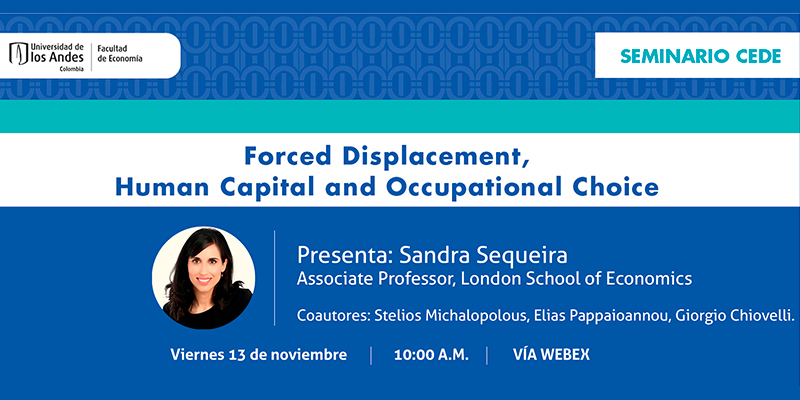
Imagen Seminario CEDE - Sandra Sequeira
Activo

Seminario CEDE - Sandra Sequeira

We examine the impact of conflict-driven displacement on investments in human capital and occupational choice, looking at the Mozambican civil war (1977-1992), one of the largest and most diverse forced displacement episodes in recent times. Mozambique's uniquely rich 1997 census allows us to trace the movement of more than 4 million individuals who were either internally displaced into cities and rural areas or externally displaced into refugee camps in neighboring countries. To overcome selection in displacement trajectories, we compare the displacement experience of siblings separated during the war, in areas equidistant (in terms of transport costs) to cities and to refugee camps. Children displaced into urban areas were more likely to invest in education and later experience a shift towards occupations outside of agriculture, even when they returned to the countryside once the war was over. Displacement to refugee camps in neighbouring countries yields no discernible differences in education and occupational specialization compared to rural non-movers. These patterns hold even when restricting our sample to twins and to siblings of the same gender and age group. Increased investments in schooling do not appear to be driven by increased access to school but instead, by a reduction in violence and by a move to areas with a higher stock of human capital, particularly cities. We then conduct a survey in one of Mozambique's largest cities to uncover the long-run impact of forced displacement. We show that displaced individuals have significantly higher education than their siblings, and that they seem to have integrated socially into urban areas, having comparable views and attitudes to non-mover city-dwellers. Yet, internally displaced individuals have lower mental health levels, lower levels of intra-community trust, and are less optimistic about economic mobility relative to city dwellers not displaced during the war. These findings underscore how forced displacement can act as a mobility shock that breaks links with subsistence agriculture, increases investments in education, and consequently increases human capital accumulation. However, it may come at the cost of decreased mental health.

10:00 am
Universidad de los Andes
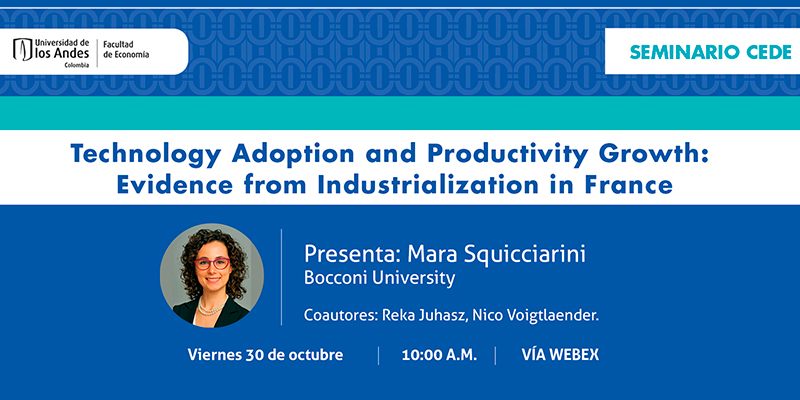
Imagen Seminario CEDE - Mara Squicciarini
Activo

Seminario CEDE - Mara Squicciarini

We construct a novel dataset to examine the process of technology adoption during a period of rapid technological change: The diffusion of mechanized cotton spinning during the Industrial Revolution in France. We document several stylized facts that can explain the well-documented puzzle that major technological breakthroughs tend to be adopted slowly and – even after being adopted – take time to be reflected in higher aggregate productivity. Before mechanization, cotton spinning was performed in households, while production in plants only emerged with the new technology around 1800. This allows us to isolate the plant productivity distribution of new technology adopters in mechanized cotton spinning and to show that this distribution was initially highly dispersed. Over the subsequent decades, cotton spinning experienced dramatic productivity growth that was almost entirely driven by a disappearance of plants in the lower tail. In contrast, innovations in other sectors (with gradual technological progress) shifted the whole productivity distribution. We document rich historical and empirical evidence suggesting that the pattern in cotton spinning was driven by the need to re-organize production under the new technology. This process of ‘trial and error’ led to widely dispersed initial productivity draws, low initial average productivity, and – in the subsequent decades – to high productivity growth as new entrants adopted improved methods of production and organization. Ver documento

10:00 am
Universidad de los Andes
Imagen Seminario CEDE - Marcela Eslava
Activo

Seminario CEDE - Marcela Eslava

Emerging economies are characterized by an extremely high prevalence of informality, smallfirm employment and jobs not fit for working from home. These features factor into how the COVID-19 crisis has affected the economy. We develop a framework that, based on accounting identities and actual data, quantifies potential job and income losses during the crisis and recovery for economies with different economic organization structures. Our analysis incorporates differential exposure of jobs across categories of firm-size and formality status, as well as sectors and occupations. We account for the direct supply shock caused by lockdowns, the idiosyncratic demand shock suffered by sectors that rely on high contact with their costumers, the transmission of both shocks through IO linkages, and the overall aggregate demand effect derived from these shocks. Applying our framework to data for Colombia, which exhibits an employment distribution similar to that of other emerging market countries, in particular Latin America, we find that well over 50% of jobs are at risk in the initial stages of the crisis. Because informal jobs and those not fit for telework are at higher risk, this number goes down to 33% if the US employment distribution is imposed on the Colombian data. As the crisis deepens, the risk of unemployment grows. However, informality rebounds quickly in the recovery, an employment at risk is quickly reduced to 20% of the baseline, all concentrated in formal jobs. Our findings point to the importance of action to maintain formal matches from dissolving, given their scarcity and rebuilding difficulty, while protecting the poor and the informal via income transfers. Ver documento  

10:00 am
Universidad de los Andes