Pasar al contenido principal

Eventos

En esta sección encontrarás la agenda de eventos académicos, conferencias, seminarios y actividades organizadas por la Facultad de Economía.

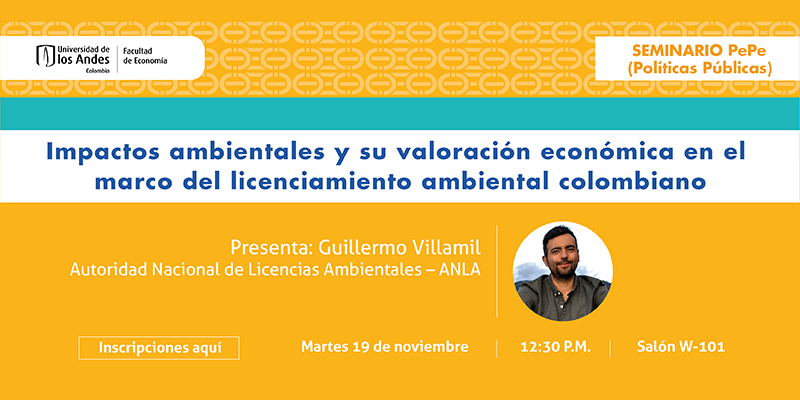
Imagen Seminario PePe - Guillermo Villamil
Activo

Seminario PePe - Guillermo Villamil

En el contexto del licenciamiento ambiental colombiano, la valoración económica ambiental comprende un conjunto de herramientas teóricas y metodológicas que brinda la economía para complementar y mejorar la calidad de los procesos de evaluación ambiental y a su vez permite fortalecer desde el sector público y privado la toma de decisiones. Este análisis busca determinar la relación entre los beneficios y los costos que se generan con la ejecución de un Proyecto, Obra o Actividad sujeta a licenciamiento. En este contexto, el proceso de evaluación económica ambiental propone una secuencia de pasos que inicia con: i) Selección de impactos significativos, para esto se pone a disposición el tablero de estandarización y jerarquización de impactos ambientales (https://www.anla.gov.co/01_anla/institucional-interno/gestion-del-conocimiento-y-la-innovacion/analitica-de-datos/tablero-control-jerarquizacion-de-impacto), en el que se pueden identificar según el sector, subsector económico y en diversas escalas regionales (municipio, departamento, zona y subzona hidrográfica, autoridad ambiental regional y áreas protegidas) los impactos más representativos además de aquellos que se presentan en territorio de forma acumulativa; ii) Cuantificación biofísica de los impactos identificados, iii) Análisis de internalización, y iv) Análisis costo beneficio de los impactos no internalizados para obtener indicadores económicos, que apoyan la definición objetiva de la viabilidad o no del proyecto.  

12:30 pm
Universidad de los Andes
Imagen Seminario PePe - Jairo Santander
Activo

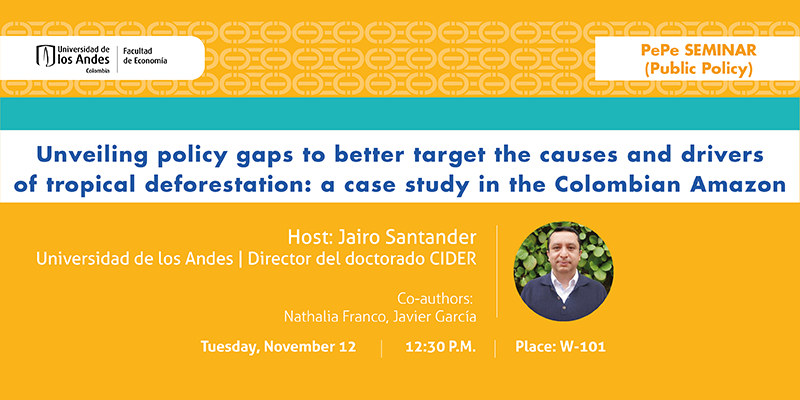
Seminario PePe - Jairo Santander

Despite a clear understanding of the factors driving deforestation and the acknowledged need to control it, tropical deforestation remains a significant social and environmental challenge. Public policy can play a crucial role in combating tropical deforestation, yet gaps in policy formulation, operationalisation, and implementation can hinder its effectiveness. There is currently a lack of detailed analysis on policy gaps, especially concerning tropical deforestation. Our study analysed the policy gaps in a deforestation frontier in the Colombian Amazon during the post-conflict period to enhance our understanding of why public policies might be inadequate in curbing deforestation. This analysis involved identifying potential gaps in the formulation, operationalisation, and implementation of a major national policy framework aimed at controlling deforestation in Colombia. To identify and delineate these policy gaps, we combined secondary literature on deforestation drivers, existing databases, institutional capacity analyses, and national statistics. Our findings indicate that land speculation, a power vacuum, the expansion of pastures, cattle ranching, and infrastructure development are driving tropical deforestation in the study area. Additionally, this process of deforestation is linked to systemic and structural challenges in institutional capacity, broadening policy gaps, such as the exclusion of the main drivers in policy formulation, a lack of local capacity and resources for policy implementation, diverging visions and preferences for regional development, centralisation, and policy obsolescence, which affect both policy operationalisation and implementation. Based on these identified gaps, we discuss potential policy interventions to address them in the study area and other tropical regions.  
12:30 pm
Universidad de los Andes
Imagen Seminario CEDE - Danilo Aristizabal
Activo

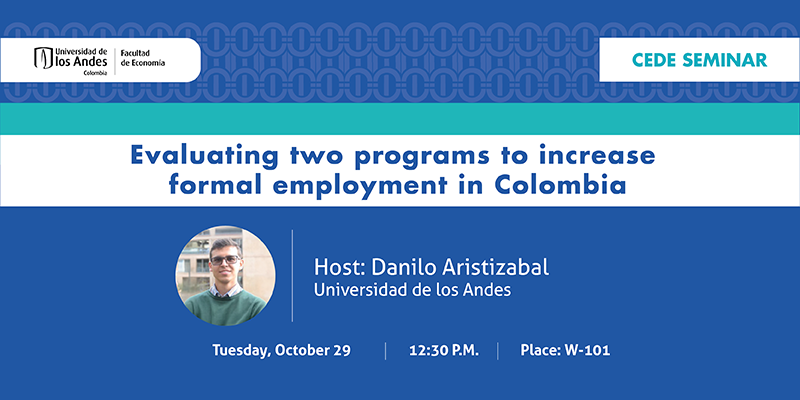
Seminario CEDE - Danilo Aristizabal

There is a close relationship between poverty and social and labor exclusion. I evaluated two ALMPs that targeted people who have difficulties in finding a formal job in a developing country. First, I analyze the effect of a training component of a labor intermediation policy (LIP) called Boost to Employment (BE) on the probability of finding a formal job for vulnerable job seekers in a developing country. I exploit the variation in the leniency among labor counselors as an instrument to approximate the probability that job seekers receive the training component. I also test which courses are the ones that helped job seekers to find formal jobs. I find that those workers who received the training component increased the probability of working in the formal sector by 21 percentage points one year after the implementation of the program compared to those workers who did not. The formal job benefits course seems to be driving my results. Second, I study the effect on labor market outcomes of a payroll tax cut for new hires of young workers under the age of 28 in an economy with a high binding minimum wage. I use exposure to wage rigidities to identify the effect. I measure an individual's exposure to wage rigidities as the gap between the median salary, in the city in which the individual lives, and the minimum wage set at the national level. I use a difference-in-difference model. I find that the effect of a payroll tax cut is asymmetric for youth who face labor markets with a binding minimum wage and those who do not.

12:30 pm
Universidad de los Andes

Conoce las publicaciones de la Facultad