Seminario CEDE - Luis Felipe Saenz
Facultad de Economía
Facultad de Economía
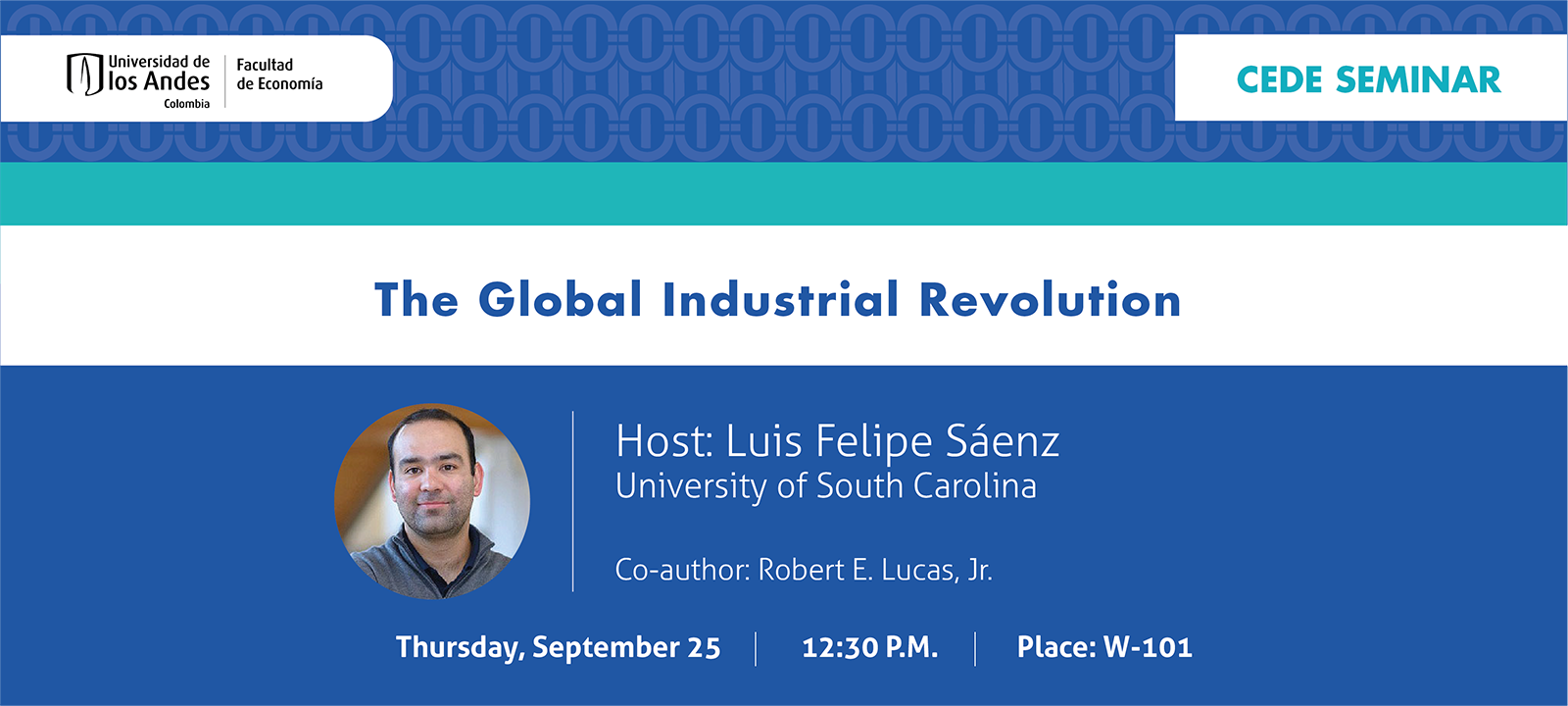
Standards of living were roughly constant before 1800, almost everywhere. In the early 19th century, English-speaking countries began a process of sustained economic growth that continues today. We document that this rise in living standardsfirst observed in Great Britain and the United Statesis now a global phenomenon. Across countries, we observe four robust patterns along the development path: (i) a reallocation of labor out of agriculture, (ii) a demographic transition, (iii) rising human capital, and (iv) a U-shaped trajectory of female labor force participation.
We develop a Unified Growth Theory in which these changes arise endogenously from household decisions. Parents choose how to allocate their time between working and raising children, and how to divide labor between a traditional land-based technology and a modern, human-capital-intensive one. A gradual rise in traditional productivity relaxes resource constraints, enabling investments in child quality. These investments, in turn, make the modern sector profitable, triggering a self-sustaining transition to growth. Calibrated to historical data, the model reproduces the main features of the global development pathincluding, critically, the U-shaped evolution of female labor force participation.