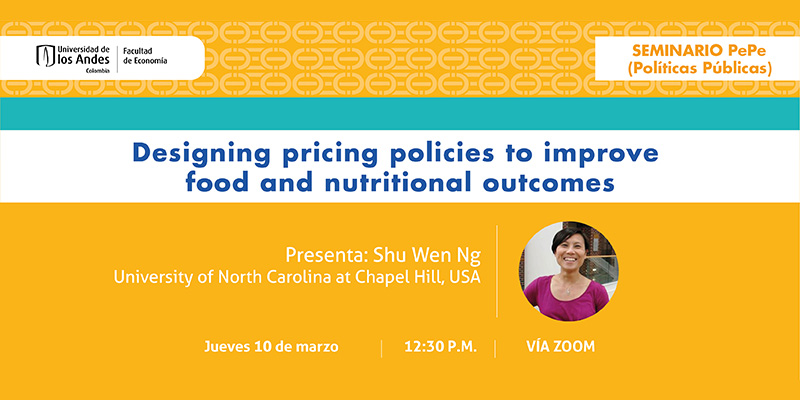
Seminario PePe (Políticas Públicas) - Shu Wen Ng
Dr Ng of the University of North Carolina at Chapel Hill in the United States has worked on evaluating the impact of sugary drink and food taxes for almost a decade, and has most recently been working evaluating the impact of financial incentive & subsidy programmes. She will take us through some options for pricing policies that increase the price of unhealthy beverages and foods (e.g., taxation, tariffs) or to decrease the price of healthier beverages and foods (e.g., subsidies, cash transfers) in order to improve diets. She will set out the growing global evidence around how, when and what about these policies seem to work better in improving diets and longer-term health. Her talk will provide some examples from across the globe that show how these solutions may be possible.
Shu Wen Ng is a health economist and Associate Professor of Nutrition at the Gillings School of Global Public Health at UNC. Her work seeks to understand individual and household-level decisions about dietary behaviors and their health impacts, accounting for the fact that decisions are constrained by monetary, time and biological factors, and are made within a broader environmental or policy context. She uses tools/approaches from economics, epidemiology, sociology and public policy, and collaborates with a mix of disciplinary experts. She is Principal and co-Investigator on several foundation and US NIH studies that use big-data on commercial store sales, household purchase, and nutrition label data at the barcode level (scanner data), alongside dietary intake and nutrition databases and policy databases. Analyzing such data, Shu Wen has studied how policies such as taxation, subsidies, incentives, front-of-pack labels, and marketing regulations affect consumer purchases, diet, nutrition, and health outcomes across many settings, and how they can help narrow existing nutritional and health disparities. Some of her earlier model-based work contributed to the evidence behind SSB taxes in Mexico and the UK, and she has been involved in conducting the impact evaluations of such taxes in Mexico, Berkeley, South Africa. She also co-chaired the US SSB tax evaluation advisory committee and is a member of the UK NIHR funded SDIL evaluation study steering committee. She leads ongoing projects in the United States, South Africa, Jamaica, Barbados, Mexico, and supports projects in Brazil, Colombia, Chile, Peru and China. She also consults for the World Bank, Singapores Health Promotion Board and New York Citys Department of Health and Mental Hygiene.