Eventos pasados

Consulta en esta sección los eventos anteriores.

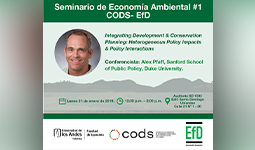
Imagen Sustentación tesis doctorado en economía
Activo

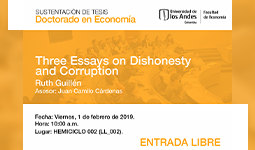
Sustentación tesis doctorado en economía

Paper 1. Are Entrepreneurs Ethically Different from Others? How Career Preferences Can Predict Dishonesty Ruth Guillén and Juan Camilo Cárdenas In this paper, we study whether individuals who are interested in initiating a business, are ethically different from others who prefer a career related to a less risky work environment, and traditionally perceived as less exposed to corruption. Using data from the Encuesta de Cultura Académica, 2013, we evaluated how different is the level of acceptance of the breaking of rules—both in the civil and academic contexts—among undergraduate students who preferred an entrepreneurial career instead of performing other occupations, such as, research tasks in academia. Also, we evaluated the seriousness that they associated with different kind of transgressions. An assumption of this study is that people who justify more breaking rules or associate less severity to transgressions could be more likely to commit unethical acts. Our results suggest that people who prefer an entrepreneurship career tend to justify the academy fraud more than subjects with other careers preferences. However, when we analyze the acceptance of breaking the law in the civil context, our findings seem to suggest that future entrepreneurs justify the breaking of the law more than others only in the circumstances related to material values, low probability of detection or when it is perceived as an adequate strategy to obtain good results. The differentiation in the acceptance of dishonest acts among these two groups of subjects was not related to their field of study. Additionally, in regards to the seriousness that subjects associated with specific types of transgressions, we found that future entrepreneurs associated less gravity to different forms of academic fraud, and in the civil context to some unethical acts, such as, to the offering of bribes. Paper 2. Can Abundance Make us Less Honest? A Bribery Game Ruth Guillén In this paper, I study from an experimental perspective whether a sudden increase of State resources increases the likelihood of economic agents to behave corruptly. I developed a theoretical framework in which emotional components such as guilt or pride are considered as variables that contribute to explaining the behavior of the subjects regarding unethical acts. Also, I designed an economic game of bribery to study the corrupt behavior of individuals under scenarios of scarcity and abundance. Corruption is quantified through the offering or the acceptance of a bribe to obtain private benefits. Results suggest that a sudden increase in the availability of public resources increases the likelihood of an individual to offer a bribe. This increase occurs even though, in the context of the game, the monetary benefit associated with the accepted of a bribe is the same in contexts of scarcity or abundance. However, the damage that corruption produces on other private agents can be perceived as lower in abundance settings. Regarding the acceptance of bribes, the data does not reveal a link between an increase in resources and an increase in the probability of accepting bribes. A possible mechanism for explaining the rise of offering bribes in a context of abundance is the subjects’ perception of decreasing costs of externalities and the consequent reduction of the guilt associated with the offering of bribes. Paper 3. Governance in a Context of Weak Accountability: Citizens’ Contributions and Misappropriation of Public Funds Ruth Guillén In this paper, I study, through a laboratory experiment, how voluntary contributions to finance the production of a good that is provided by a central authority (government) evolve in a context of weak accountability. Also, I evaluate the effectiveness of three institutions, based on communication, rather than pecuniary punishments to induce authorities to behave properly when managing resources, and how such strategic behavior can affect others contributions. In the baseline setting, people decide simultaneously the amount of their endowment they want to place in a public fund that doubles in value before it is distributed among all players. Then, a randomly selected player decides how to distribute the social surplus generated from the voluntary provision, including the possibility of capturing part of the rents; the allocator does not face a formal punishment for his decisions. I test the following signaling among group members against a baseline scenario: i) sending a non-binding message, ii) sending a binding message, and iii) sending a message of satisfaction. Both students and actual public officers participated in this study. Results show that contributions in a context of weak accountability do not decrease significantly over time under the baseline scenario. Also, I find that sending a message of satisfaction from contributors to allocators might be an effective policy to promote cooperation from those who contribute to the production of the good. Furthermore, sending a binding message from allocators to beneficiaries constrained their opportunistic behaviors regarding the appropriation of public resources when participants were students, but in the case of officers, this effect was only observed temporarily. Finally, I do not find effects linked to sending a non-binding message.

10:00 am
Universidad de los Andes
Imagen Seminario y visita de Glen Weyl
Activo

Seminario y visita de Glen Weyl

El próximo lunes 21 de enero tendremos una visita express de Glen Weyl a Bogotá. Aprovechamos esta visita para tener un seminario académico y una reunión sobre el proyecto RadicalXChange con Glen.  Glen es un académico de primer nivel internacional. En los últimos años se ha desempeñado como investigador en Microsoft Research. Pero su proyecto más ambicioso recientemente fue la publicación, en co-autoría con Eric Posner (U de Chicago) "Radical Markets". Este libro ha sido reseñado en revistas como The Economist y Forbes, entre otras, como uno de los libros más importantes del 2018 y los autores han sido mencionados como unos de los pensadores jóvenes más influyentes del momento en varios medios especializados y académicos. El lunes 21 de enero de 3:30 p.m. a 4:50 p. m. en el Salón B 203, Bloque B de la Universidad de los Andes. Portería más cercana Bloque G (Cra. 1 Nº 18A - 12).  Glen Weyl presentará un seminario titulado "Political Economy For Increasing Returns"  Abstract The very existence of civilization implies that increasing returns must pervade economic life. Yet neoliberal capitalism is wildly inefficient in the presence of increasing returns and standard democracy is far too rigid to address this failure. Drawing on novel, approximately optimal market mechanisms for increasing returns, I will sketch what a political economy adapted to increasing returns would look like. Nearly all consumption would be in the form of public goods and most private property would belong to a range of communities. A rich plurality of emergent public good-providing communities would replace democratic states and monopolistic corporations. The distinction between economics and political science, and between methodological individualism and communitarianism, would dissolve. This vision suggests many intellectual directions and a social ideology I call Liberal Radicalism.

03:30 pm
Universidad de los Andes
Imagen 1st Annual Colombian Economics Conference
Activo

1st Annual Colombian Economics Conference

Free and open to the public | Registration 8th floor, Edificio Santo Domingo - SD de la Universidad de los Andes (Calle 21 Nº 1 - 20).   8:00 - 8:15 a.m. | Registration and Cofee  8:15 - 8:30 a.m. |  Welcome - Salón SD 801 8:30 - 10:30 a.m. | Parallel Sessions 1   Political Economy-Empirical - Salón SD 801 Leopoldo Fergusson, Universidad de los Andes | Do Ghosts Exist? Corruption in the Colombian Education System Sandra Rozo, Marshall  School  of  Business | Brothers or invaders? How crises-driven migrants shape voting behavior Mounu Prem, Universidad del Rosario | The Geography of Repression and Support for Democracy: Evidence from the Pinochet Dictatorship Leonardo Bonilla, Banco de la República | Jam-barrel politics: Road building and legislative voting in Colombia   Macro Labor - Salón SD 802 Christian Posso, Banco de la República | Solving the puzzle between the minimum wage and employment: an analysis for a developing economy Camilo Morales-Jimenez, Federal  Reserve  Board  | Dynamic and Stochastic Search Equilibrium Daniel Wills, Universidad de los Andes | Optimal Taxation and Informality Juan Fernando Duque, Universidad  EAFIT | The employment effects of offshoring in developing countries: empirical evidence from Colombia   Finance - Salón SD 803 Francisco Palomino, Federal  Reserve  Board  | An Irrelevance Theorem for Risk Aversion and Time-Varying Risk David Echeverry, University  of  Notre  Dame | Information Frictions in Securitization Markets: Unsophisticated Investors or Opaque Assets? Alejandro Rivera, University  of  Texas | Extrapolation Bias and Optimal Liquidity Management Alvaro Riascos, Universidad de los Andes | Unit Commitment, Opportunity Costs and Market Power in a Structural Model of the Colombian Spot Electricity Market 10:30 - 11:00 a.m. | Coffee Break 11:00 a.m. -12:30 p.m. | Parallel Sessions 2 Political Economy - Salón SD 801 Oskar Nupia, Universidad de los Andes | Campaign Finance Policies when Money Mobilizes Voters But Harm Public Projects Jorge Gallego, Universidad del Rosario | The Political Economy of Patrons, Brokers, and Voters Luis Felipe Sáenz, University  of  South  Carolina | Income, Education and Democracy Interational/Trade - Salón SD 802 Margarita Lopez Forero, Paris  1  University  -  Paris  School  of  Economics | The proximity-concentration trade-off with multi-product firms: Are exports and FDI complements or substitutes? Juan David Torres-Alarcón, Banco de la República | Putting the eggs in multiple baskets: a quasi-experimental approach to export promotion in Colombia during the 1960s Juan Cordoba, Iowa  State  University | Accounting for the International Quantity-Quality Trade-off Macro - Salón SD 803 Marla Ripoll, University  of  Pittsburgh | The Elasticity of Intergenerational Substitution, Parental Altruism and Fertility Choice Mauricio Rodriguez, Universidad del Rosario | The Cost of the Status Quo: Exploration Or Innovation in the Face of Scarcity Nicolas Suárez, Banco de la República | Digital Payments Adoption and the Demand for Cash: New International Evidence  12:30 - 2:00 p.m. | Lunch Break - The Department of Economics at Universidad de los Andes will offer lunch to presenters and faculty members 2:00 p.m. - 3:30 p.m. | Parallel Sessions 3 Crime/Conflict - Salón SD 801 Juan Vargas, Universidad del Rosario | Killing Social Leaders for Territorial Control: The Unintended Consequences of Peace Mateo Vasquez-Cortes, New  York  University | Criminality as a Social Process: Evidence From Colombian Ex-Combatants Juan Sebastián Muñoz, University of Illinois Urbana-Champaign | Unraveling Place-Based Preferences: Do School Shootings Erode Property Values?   Macro Empirical - Salón SD 802 David Perez-Reyna, Universidad de los Andes | Contracts, Firm Dynamics and Aggregate Productivity Dairo Estrada & Camilo De Los Rios, Banco de la República | Financial Stability and Financial Inclusion in Colombia Jose E. Gómez-González, Banco de la República | Bank Market Power and Firm Finance: Evidence from Bank and Loan Level Data   Health/Labor Applied - Salón SD 803 Ryan Brown, University  of  Colorado  Denver | Cognitive Development and Infectious Disease: Gender Differences in Investments and Outcomes Paul Rodríguez-Lesmes | The causal effect of contraceptive efforts on intimate partner violence: evidence from the Zika crisis in Colombia Andrea Velásquez, University  of  Colorado  Denver | The Effects of Increasing Immigration Enforcement on the Labor Supply of High-Skilled Native Women 3:30 - 4:00 p.m. | Coffee Break  4:00 - 5:30 p.m. | Parallel Sessions 4   Education - Salón SD 801 Andres Moya, Universidad de los Andes | Equality of Opportunity and Human Capital Accumulation: Motivational Effect of a Nationwide Scholarship in Colombia Carolina Arteaga, UCLA | The Cost of Bad Parents Felipe Valencia (UBC) | Tordesillas, Slavery and the Origins of Brazilian Inequality   Firms level macro/IO - Salón SD 802 Marcela Eslava, Universidad de los Andes | The life cycle growth of plants: the role of productivity, demand, and “distortions” Juanita Gonzalez-Uribe, LSE | Identifying and Spurring “Gazelles”: Evidence from a Business Accelerator Juan Camilo Castillo, Stanford  University | Who Benefits from Surge Pricing? 5:30 p.m. - 7:00 p.m. | Closing Event  We encourage you to share some beers at BBC Bodega at CityU (walking distance from the Department of Economics).
08:00 am
Edificio Santo Domingo, Universidad de los Andes
Imagen Seminario educación, juventudes y la guerra contra las drogas
Activo

Seminario educación, juventudes y la guerra contra las drogas

La militarización de la política de drogas y la evolución simultánea de las redes delictivas involucradas en el tráfico ilícito de drogas han cobrado cientos de miles de vidas, entre ellas las de niños, niñas y jóvenes. En este evento analizaremos las consecuencias de dichas políticas en el sector educativo y presentaremos alternativas que se han diseñado para responder a los diferentes tipos de violencia causadas por la criminalización de las drogas desde el Estado, los movimientos sociales y los espacios educativos no formales.   Agenda   Bienvenida   2:00 p.m. Bienvenida Ana Arjona, CESED, Universidad de los Andes, Colombia   Palabras de apertura Diana Rodríguez y María José Bermeo, Universidad de los Andes, Colombia   2:10 p.m. Educación y construcción de paz de la mano de la transformación de la hoja de coca Herney Ruiz, Escuela Agroambiental Arraigo del Espacio de Paz y de Convivencia de Lerma, Colombia   Panel 1   2:30 p.m. El nexo entre la Guerra en contra de las drogas y la educación: una mirada crítica a la producción del conocimiento Diana Rodríguez Gómez, Universidad de los Andes, Colombia María José Bermeo, Universidad de los Andes, Colombia Andrés Ramírez, Universidad Distrital Francisco José de Caldas, Colombia   Redadas policiales con foco en drogas: el impacto de la acción policial sobre niños y jóvenes Eduardo Vergara, Laboratorio de Seguridad, Chile   Las y los jóvenes como agentes de cambio dentro de la política de drogas en Latinoamérica: el caso de Estudiantes por una Política Sensata de Drogas Latinoamérica Emma Rodríguez, Universidad Autónoma Metropolitana Unidad Xochimilco, México   Pedagogía en torno a sustancias psicoactivas: re-educándonos para educar sobre sustancias psicoactivas Julie Benavides, Universidad Pedagógica Nacional, Colombia Michael Zapata, Universidad Pedagógica Nacional, Colombia   3:30 p.m. Conversatorio 4:00 p.m. Receso.   Panel 2   4:20 p.m. Experiencias de la asociación “Colmena Juvenil" María Fernández, Asociación Colmena Juvenil, Bolivia   Catalizador: una educación más allá de la reducción de daños Theo di Castri, Catalizador, México   Brigada Política de Drogas, un discurso alternativo en la educación sobre drogas para las personas jóvenes de la Ciudad de México y Latinoamérica. Julian Yunda, Brigada Política de Drogas, México   Proyecto “Échele cabeza cuando se dé en la cabeza” Julian Quintero, Échele Cabeza - Acción Técnica Social, Colombia Vanessa Morris, Échele Cabeza - Acción Técnica Social, Colombia   Programas de prevención del consumo de drogas en la educación no formal en América Latina y el Caribe: Una caracterización desde las iniciativas gubernamentales Noé González, Instituto Tecnológico y de Estudios Superiores de Monterrey, México Gabriela Maldonado, Universidad de Los Andes, Colombia Alejandro Cortés, Universidad de Los Andes, Colombia Daniel Orlando del Rio, Universidad de Los Andes, Colombia   5:35 p.m.                 Conversatorio 

02:00 pm
Salón ML-617
Imagen Dosis mínima de psicoactivos y salud pública
Activo

Dosis mínima de psicoactivos y salud pública

Organiza:  Centro de Estudios sobre Seguridad y Drogas – CESED, Facultad de Economía de la Universidad de los Andes.  Facultad de Medicina - Maestría de Salud Pública - Universidad de los Andes Asociación Colombiana de Sociedades Científicas Asociación Colombiana de Salud Pública Bogotá Cómo Vamos Objetivo: El Decreto 1844 del 2018 otorga la potestad a la Policía Nacional de iniciar un proceso contra las personas que porten cualquier cantidad de drogas (incluso menor a la dosis mínima) y de destruirla. Con el objetivo de evaluar las implicaciones de este decreto, el conversatorio busca revisar qué dice la evidencia nacional e internacional sobre el manejo desde la salud pública de la dosis mínima.   Agenda:  Instalación Ana Arjona, directora del CESED y Natalia Mejía, Decana Facultad de Medicina Introducción al panel : Luis Jorge Hernandez, Profesor de la Universidad de los Andes.   9:00 - 10:15 a.m. ¿Qué dice la evidencia jurídica y la evidencia en salud pública? ¿Cuáles son las alternativas? Panelistas: · Daniel Suarez, Médico Psiquiatra (Universidad de los Andes) · Adriana Muro, Directora de Elementa (Elementa) · Pablo Zuleta, Médico Psiquiatra (Universidad de los Andes) · Augusto Pérez, Psicólogo (Nuevos Rumbos)   10:15 a.m. - 10:30 a.m. Receso.   10:30 - 11:45 p.m. Aspectos ético-políticos Panelistas: · Alejandro Gaviria (Universidad de los Andes) · Rodrigo Uprimny (Dejusticia) Moderador y conclusión del panel: Carlos Francisco Fernández, Médico y Editor de El Tiempo.

09:00 am
Salón ML-617