Eventos pasados

Consulta en esta sección los eventos anteriores.

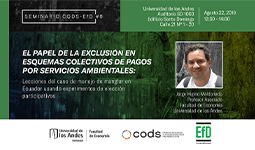
Imagen Seminario CODS-EFD No. 6
Activo

Seminario CODS-EFD No. 6

Resumen: Los esquemas de Pagos por Servicios Ambientales se han implementado para buscar el uso sostenible de los ecosistemas y los servicios que estos proveen. Sin embargo, la tenencia informal y la escasa capacidad de hacer efectivos los derechos de propiedad reducen las posibilidades de implementación de esta herramienta. Estos fenómenos son comunes en áreas marinas y costeras donde las comunidades locales enfrentan el deterioro de los recursos de uso común allí presentes. Una estrategia para superar estas limitaciones es la asignación de derechos de propiedad a usuarios organizados. No obstante, esta situación puede generar inconformidad y sensación de inequidad en los usuarios que pierden el acceso a los recursos. En este contexto, este estudio utiliza experimentos de elección para analizar las preferencias y la disponibilidad a aceptar, por parte de habitantes en comunidades locales costeras, de un acuerdo de conservación que combina un incentivo económico con una concesión para el uso sostenible de manglares en Ecuador. El objetivo principal es identificar cómo la imposición de normas de exclusión a otras comunidades motiva o previene la participación de usuarios en acuerdos para el manejo de RUC, basados en la asignación de derechos de propiedad. Encontramos que contar con la capacidad de definir el alcance de las normas de exclusión sí importa al momento de tomar la decisión de participar en la estrategia de manejo y conservación propuesta. Además, mostramos que esta preferencia es heterogénea entre individuos y contribuimos a la discusión sobre la importancia de entender el contexto y las preferencias de los usuarios en el diseño de programas de conservación.

12:30 pm
Universidad de los Andes
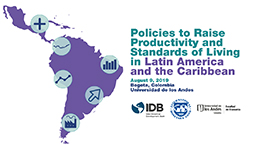
Imagen Policies to raise productivity and standards of living in Latin America and the Caribbean
Activo

Policies to raise productivity and standards of living in Latin America and the Caribbean

Date & Time: Friday, August 9, 2019 | 8:00 a.m. - 5:00 p.m  Location: Auditorio ML - C, edificicio Mario Laserna- Universidad de los Andes  A top challenge policymakers face is how to raise productivity, the key driver of living standards over the long term. Drawing upon rich micro-level datasets from the region and structural economic models, in this conference we aim to address questions such as: How does the misallocation of resources contribute to low levels of productivity in the region? What economic sectors are most affected by this misallocation of resources, and how is this associated with adverse firm dynamics in the region? What role do current labor market regulations, tax regimes, and fiscal incentives for private investment play in undermining productivity in a context of high informality. The conference will conclude with a policy panel focusing on policies needed to boost productivity and lift growth.  Agenda 8:15  – 8:30 Welcome remarks, opening statement (Inter-American Development Bank/International Monetary Fund/ Universidad de los Andes) Session 1 | 8:30 – 10:30 Formal and Informal Firm Dynamics | Gabriel Ulyssea, Oxford University. Trade, Farmers' Heterogeneity and Agricultural Productivity: Evidence from Colombia | Margarita Gafaro, Banco de la República de Colombia Informality and Aggregate Productivity: The Case of Mexico | Jorge Álvarez, International-Monetary Fund Establishment dynamics and the persistence of resource misallocation in Mexico | Jesica Torres, Inter-American Development Bank Coffee break | 10:30 – 11:00 Session 2 | 11:00 – 1:00 Policies that have raised productivity and standards of living in Colombia | Marcela Eslava, Universidad de los Andes Optimal Taxation and Informality | Daniel Wills, Ministerio de Hacienda y Crédito Público Informality & productivity. The case of Colombia | Cristina Fernandez, Fedesarrollo.   Lunch break | 1:00 – 2:30 Keynote speaker: Diego Restuccia, University of Toronto | 3:00 – 3:45   Coffee break | 3:45 - 4:00  Discussion panel: Policies to boost productivity and growth | 4:00 - 5:00  Discussants: Gabriel Ulyssea, Oxford University Diego Restuccia, University of Toronto Marcela Eslava. Universidad de los Andes. Ministerio de Hacienda. Moderator: Era Dabla-Norris, Division Chief, Fiscal Operations - IMF
08:00 am
Universidad de los Andes
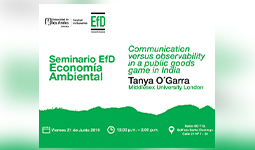
Imagen Seminario EFD economía ambiental
Activo

Seminario EFD economía ambiental

Abstract:  This study is an empirical investigation of the potential for communication and observability interventions to increase cooperation around communal water treatment systems amongst villagers in rural India. Despite the dependence of many rural communities in India on communal water sources and treatment plants for safe drinking water, they often fail to collectively manage these resources, resulting in abandoned water points and treatment systems with consequent health and mortality impacts. Results of public goods games framed in terms of the management of communal water treatment systems suggest that these communities can cooperate to provide the public good. However, public disclosure of behaviour had the very significant effect of decreasing contributions to the public good. Analysis indicates that early rounds of play were critical in this regard: the observed behaviours of other individuals at the start of play strongly determined subsequent cooperation levels. Thus, frequently-observed free-riding behaviour in early rounds of the game led other players to follow suit. Only when participants were actively encouraged to negotiate agreements, did cooperation increase significantly - albeit intermittently. Overall, findings suggest that interventions that provide opportunities for communication and negotiation may be most effective at enhancing cooperation around communal water treatment plants, while the impacts of interventions that make behaviour observable are strongly dependent on behaviour in the early stages of cooperative interaction.  

12:30 pm
Universidad de los Andes