Seminario PePe - Jairo Santander
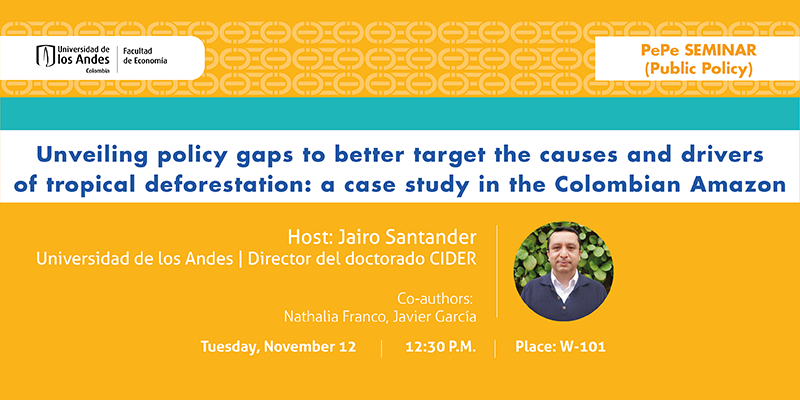
Despite a clear understanding of the factors driving deforestation and the acknowledged need to control it, tropical deforestation remains a significant social and environmental challenge. Public policy can play a crucial role in combating tropical deforestation, yet gaps in policy formulation, operationalisation, and implementation can hinder its effectiveness. There is currently a lack of detailed analysis on policy gaps, especially concerning tropical deforestation. Our study analysed the policy gaps in a deforestation frontier in the Colombian Amazon during the post-conflict period to enhance our understanding of why public policies might be inadequate in curbing deforestation. This analysis involved identifying potential gaps in the formulation, operationalisation, and implementation of a major national policy framework aimed at controlling deforestation in Colombia. To identify and delineate these policy gaps, we combined secondary literature on deforestation drivers, existing databases, institutional capacity analyses, and national statistics. Our findings indicate that land speculation, a power vacuum, the expansion of pastures, cattle ranching, and infrastructure development are driving tropical deforestation in the study area. Additionally, this process of deforestation is linked to systemic and structural challenges in institutional capacity, broadening policy gaps, such as the exclusion of the main drivers in policy formulation, a lack of local capacity and resources for policy implementation, diverging visions and preferences for regional development, centralisation, and policy obsolescence, which affect both policy operationalisation and implementation. Based on these identified gaps, we discuss potential policy interventions to address them in the study area and other tropical regions.