Seminario CEDE - Joana Duran-Franch
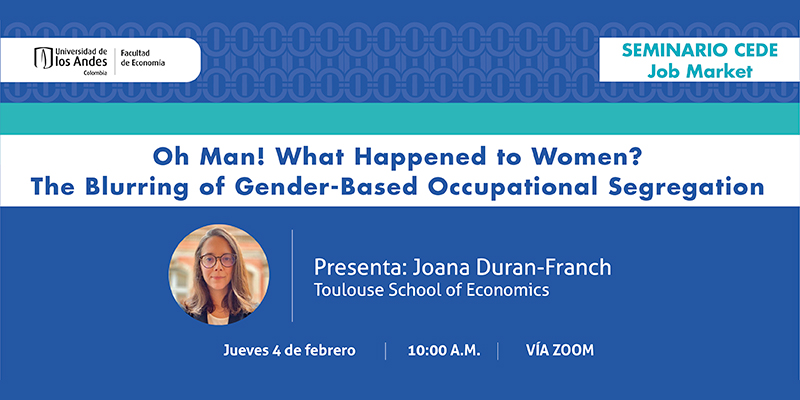
The participation of women in the U.S. labor market increased during the past century. However, progress stalled and since 2000 the employment rate of women has not progressed. These changes are driven by the least educated women who have decreased their employment rate. In parallel, potential employment opportunities for this demographic group have grown: Service and clerical occupations, traditional sources of employment for low-educated women, have experienced employment growth over this period. I show empirically that the decline of employment in blue-collar occupations helps reconcile these two facts: Low-educated men, employed in blue-collar occupations and now out of employment, entered services and clerical occupations; blurring the existing gender-based occupational segregation and crowding some low-educated women out. I establish a causal link between these changes using an IV strategy and exploiting the cross-section variation at the local labor market level. I formalize a static general equilibrium model where individuals, who are heterogeneous in gender, education level and skills, decide which occupation type to sort into. The model is able to replicate the labor reallocation observed in the data by gender and level of education. The model shows that demographic changes have masked the effect of the demanualization in the labor market. The demanualization, driven by labor-saving technology improvements in blue-collar occupations, has decreased the aggregate employment rate of low-educated women from 1990-2016 by 8.1 percentage points, the same magnitude by which it has affected men. For men, the aggregate effect is smaller than the direct one on blue-collar employment, since low-educated men have relocated to other occupations. For women, 51% of the aggregate change corresponds to the direct effect on blue-collar employment; 49%, to the indirect crowding-out effect.