Eventos

En esta sección encontrarás la agenda de eventos académicos, conferencias, seminarios y actividades organizadas por la Facultad de Economía.

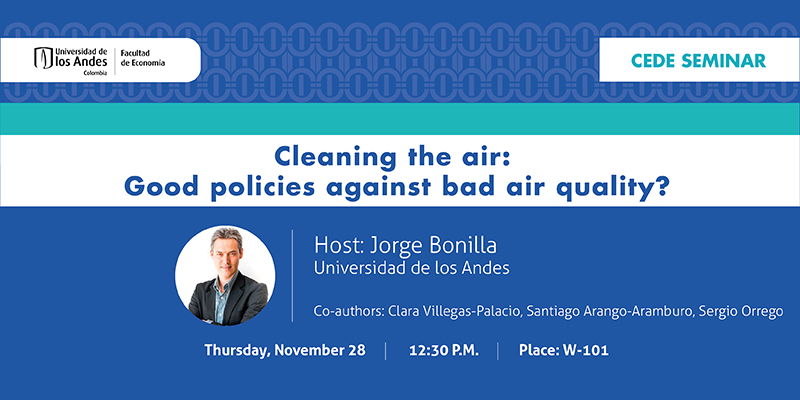
Imagen Seminario CEDE - Jorge Bonilla
Activo

Seminario CEDE - Jorge Bonilla

Short-term exposure to air pollution increases the risk of respiratory diseases. This risk is higher during critical air quality events when episodes last for several days and are harmful to the most vulnerable groups. A common strategy in Latin America is temporarily adjusting transport policies to reduce emissions and the impact on people's health. Medellín, Colombia's second-largest city, and the Aburrá Valley Metropolitan Area have been implementing driving restrictions since 2017, which, unlike other cities, not only banned cars but also restricted the circulation of motorcycles and trucks. Restrictions that quickly became stricter for old vehicles. Using a two-way-fixed effects model, we empirically evaluate the effectiveness of the implemented plan between 2017 and 2019 on pollutant concentrations and examine the impact on vehicle trips, noise, and possible changes in regular on-road tests of vehicle environmental performance. Our results show that the implemented plan has reduced air pollution by 2%-24% for several pollutants. The red alerts, introduced with the strictest bans, showed the largest reduction. Particulate matter showed the most significant improvement in air quality. In general, reductions in air pollutant concentrations tend to be greater when restrictions apply to trucks or older vehicles and when bans cover more license plates. Vehicle trips and noise also declined, and there is some evidence of an increase in on-road vehicle testing. These findings suggest that introducing differentiated restrictions focalizing the most stringent bans on the most polluting vehicles is an effective policy to reduce air pollution during short-term episodes of poor air quality.  

12:30 pm
Universidad de los Andes
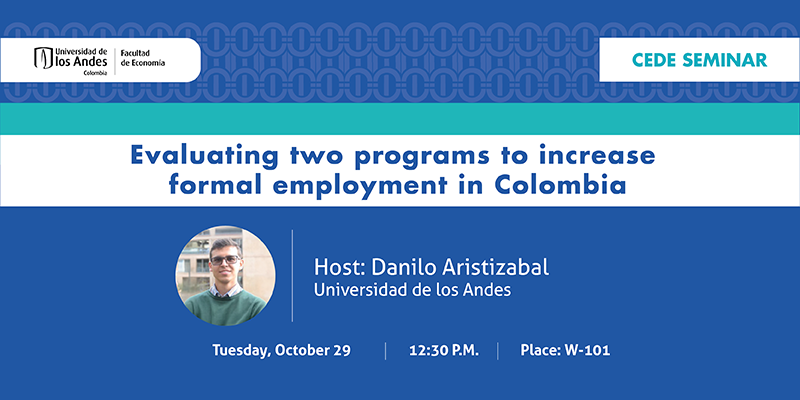
Imagen Seminario CEDE - Danilo Aristizabal
Activo

Seminario CEDE - Danilo Aristizabal

There is a close relationship between poverty and social and labor exclusion. I evaluated two ALMPs that targeted people who have difficulties in finding a formal job in a developing country. First, I analyze the effect of a training component of a labor intermediation policy (LIP) called Boost to Employment (BE) on the probability of finding a formal job for vulnerable job seekers in a developing country. I exploit the variation in the leniency among labor counselors as an instrument to approximate the probability that job seekers receive the training component. I also test which courses are the ones that helped job seekers to find formal jobs. I find that those workers who received the training component increased the probability of working in the formal sector by 21 percentage points one year after the implementation of the program compared to those workers who did not. The formal job benefits course seems to be driving my results. Second, I study the effect on labor market outcomes of a payroll tax cut for new hires of young workers under the age of 28 in an economy with a high binding minimum wage. I use exposure to wage rigidities to identify the effect. I measure an individual's exposure to wage rigidities as the gap between the median salary, in the city in which the individual lives, and the minimum wage set at the national level. I use a difference-in-difference model. I find that the effect of a payroll tax cut is asymmetric for youth who face labor markets with a binding minimum wage and those who do not.

12:30 pm
Universidad de los Andes
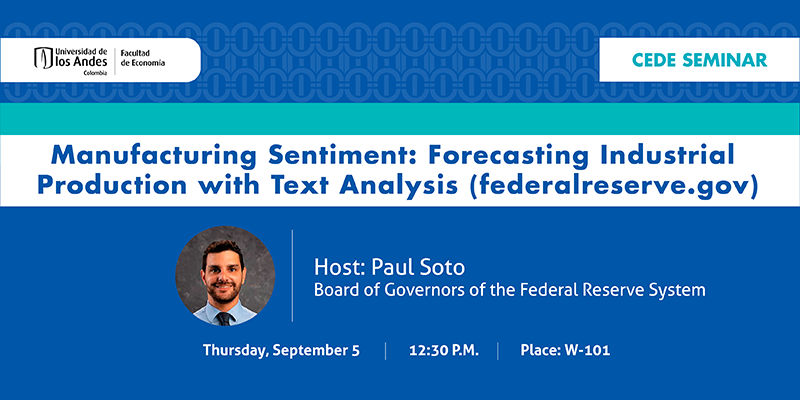
Imagen Seminario CEDE - Paul Soto
Activo

Seminario CEDE - Paul Soto

This paper examines the link between industrial production and the sentiment expressed in natural language survey responses from U.S. manufacturing firms. We compare several natural language processing (NLP) techniques for classifying sentiment, ranging from dictionary-based methods to modern deep learning methods. Using a manually labeled sample as ground truth, we find that deep learning models--partially trained on a human-labeled sample of our data--outperform other methods for classifying the sentiment of survey responses. Further, we capitalize on the panel nature of the data to train models which predict firm-level production using lagged firm-level text. This allows us to leverage a large sample of "naturally occurring" labels with no manual input. We then assess the extent to which each sentiment measure, aggregated to monthly time series, can serve as a useful statistical indicator and forecast industrial production. Our results suggest that the text responses provide information beyond the available numerical data from the same survey and improve out-of-sample forecasting; deep learning methods and the use of naturally occurring labels seem especially useful for forecasting. We also explore what drives the predictions made by the deep learning models, and find that a relatively small number of words--associated with very positive/negative sentiment--account for much of the variation in the aggregate sentiment index.  

12:30 pm
Universidad de los Andes

Conoce las publicaciones de la Facultad