Eventos

En esta sección encontrarás la agenda de eventos académicos, conferencias, seminarios y actividades organizadas por la Facultad de Economía.

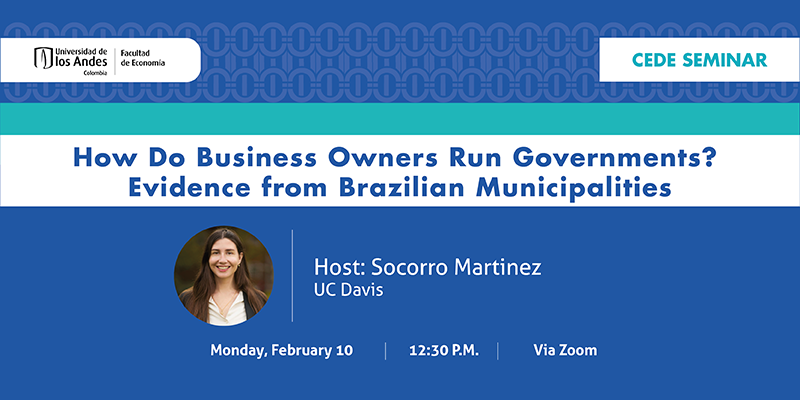
Imagen Seminario CEDE - Socorro Martinez
Activo

Seminario CEDE - Socorro Martinez

Effective government leadership demands skills in planning, budgeting, and personnel management, areas where business experience may be valuable. Business owners could apply their management skills in public administration to optimize resources, enhance public service delivery, or promote private sector growth. However, these skills may not translate to the public sector, where different rules prevail, and a lack of political expertise could ultimately undermine the delivery of public services. This paper studies the impact of electing business owners as mayors in Brazilian municipalities. By leveraging a national business registry from the Brazilian Federal Revenue Agency that includes information on the owners, merged with candidates’ data from the Electoral High Court, I identify business candidates. Using a regression discontinuity design for close elections, I find that electing a business mayor reduces municipal revenue by 7.5% and spending by 8%. Evidence suggests that the reduction in revenue may be due to challenges in accessing intergovernmental transfers, indicating that managerial experience may come at the expense of political skills. Despite the decrease in spending, business mayors do not negatively affect public service delivery or local economic activity. I find no impact on health outcomes and a small but positive effect on private sector employment. These results indicate improvement in cost-effectiveness by achieving equivalent service levels with fewer resources. I examine management as a driver of increased effectiveness and find that business mayors do not improve personnel management outcomes, suggesting a limited ability to transfer or adapt their management experience to the public sector.  
12:30 pm
Universidad de los Andes
Imagen Seminario CEDE - Francisco Eslava
Activo

Seminario CEDE - Francisco Eslava

This paper examines whether female leadership can reduce violence in the context of the Colombian conflict. To identify the effect, I leverage closely contested local elections between male and female candidates, alongside a novel dataset with the location and gender of guerrilla unit commanders. I find that female leadership has a negative effect on conflict violence that amounts to a 60% reduction in the most demanding specification. I document even larger reductions in violence when both a female mayor and a female guerrilla commander are present, revealing that synergies between female leaders on opposing sides of the conflict further contribute to de-escalation. To understand the reasons behind this reduction in violence, I use text analysis on a novel dataset of campaign statements, revealing that female mayors employ less confrontational language when addressing the conflict. Additionally, I leverage timing of conflict events to show that guerrilla units with female commanders are less likely to retaliate following unilateral attacks. I interpret these patterns as evidence of a genderbased preference for de-escalation. Finally, to study how these preferences translate into lower violence, I build a simple theoretical model to show that gender differences in “negotiation skills” can account for the observed empirical patterns. Testing the model’s predictions and ruling out alternative explanations, I conclude that female leaders consistently opt for de-escalation over violent confrontation whenever possible.

12:30 pm
Universidad de los Andes

Conoce las publicaciones de la Facultad