Eventos

En esta sección encontrarás la agenda de eventos académicos, conferencias, seminarios y actividades organizadas por la Facultad de Economía.

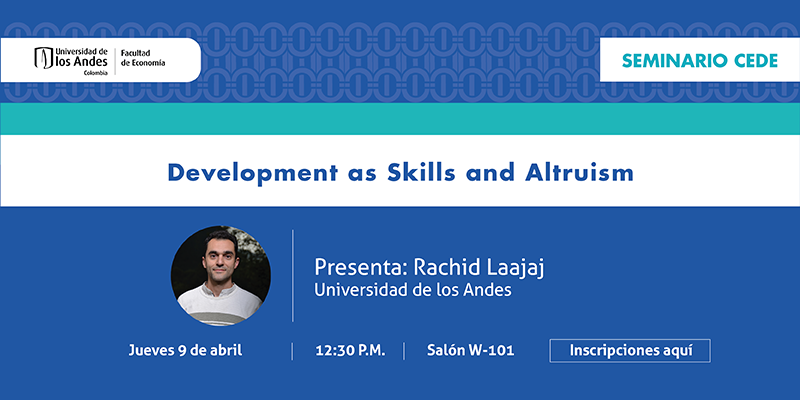
Imagen Seminario CEDE - Rachid Laajaj
Activo

Seminario CEDE - Rachid Laajaj

This work emphasizes the central role of skill and altruism in development, understood as an increase in social welfare. In the basic model, skill expands the set of feasible payoffs, while altruism governs the private–social tradeoff in the decision maker’s choice. Higher altruism consistently increases social welfare. By contrast, higher skill needs not: capability expansions combine a positive frontier effect with an ambiguous reallocation effect, potentially toward actions that are privately attractive but socially harmful. When altruism is absent or low, whether more skill contributes to development is therefore subject to a “lottery of technology.” Hence altruism acts as a guardrail, limiting misuse of technology, thus when altruism is sufficiently high, skill improvement unambiguously raises social welfare. The rest of the paper discusses possible counterarguments to the central role of altruism in development. Endogenous technological change makes altruism more influential in the long-run. The effect of institutions is subject to a “lottery of alignment of interests” (between policymakers’ objectives and social welfare), unless the altruism of policymakers is high enough to ensure the good use of institutional power. Allowing altruism to be group-specific highlights that only universal, indiscriminate altruism guarantees development and the effective use of skill improvement. This basic setting appears to speak to many contemporaneous and historical events, and the role of altruism leads to the conclusion that ensuring long-term development requires a selection of altruistic leaders and a shift in the distribution of altruism.

12:30 pm
Universidad de los Andes
Imagen Seminario CEDE - Jorge Cuartas
Activo

Seminario CEDE - Jorge Cuartas

La violencia contra la primera infancia constituye una de las mayores amenazas para la acumulación de capital humano y para las trayectorias educativas, sociales y económicas a lo largo del ciclo de vida. Sin embargo, algunas de sus formas, como el castigo físico, siguen siendo socialmente normativas y altamente prevalentes. En esta charla presentaré evidencia empírica sobre los efectos del castigo físico en el desarrollo humano, con énfasis en los principales desafíos asociados a la identificación causal, así como a la validez externa de los estudios existentes. A continuación, reflexionaré sobre una alianza de investigación–práctica con el Gobierno de Colombia orientada al diseño, evaluación y escalamiento de Apapacho, un programa de prevención de la violencia en la primera infancia. Mostraré cómo integramos (1) teoría económica, psicología y ciencias de la implementación con (2) evidencia empírica proveniente de una evaluación experimental con más de 2.500 madres, padres y otros cuidadores de niños y niñas en primera infancia, así como pilotos y estudios de métodos mixtos, para maximizar la efectividad, aceptabilidad, relevancia, factibilidad y sostenibilidad del programa. Concluiré discutiendo cómo el trabajo interdisciplinario, aplicado y colaborativo con responsables de política puede aumentar de manera sustantiva la efectividad y escalabilidad de intervenciones orientadas a promover el desarrollo infantil temprano.
12:30 pm
Universidad de los Andes
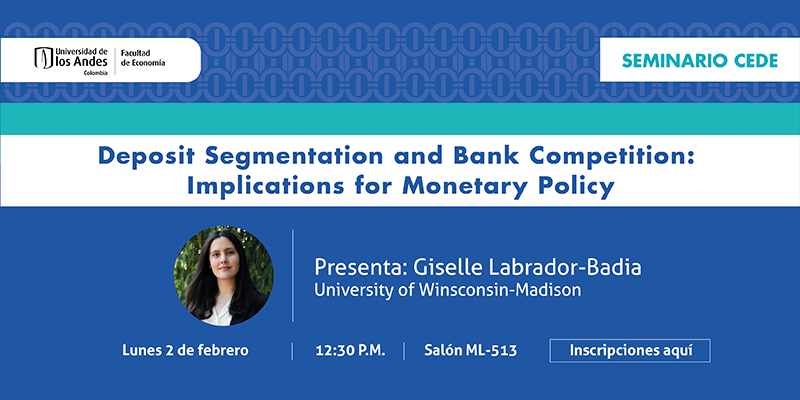
Imagen Seminario CEDE - Giselle Labrador-Badia
Activo

Seminario CEDE - Giselle Labrador-Badia

This paper quantifies how segmentation and bank market power in deposit markets shape the transmis sion of monetary policy. Using rate data differentiated by deposit account size, I document that uninsured rates are higher than insured rates, significant heterogeneity in banks’ uninsured deposit exposure, and in complete pass-through from policy rates to deposit rates. I develop and estimate a structural model of bank competition with segmented deposit markets by insurance status and spatial competition to understand these patterns and quantify their implications for monetary transmission. I find that uninsured deposits are slightly more elastic than insured deposits, while insured deposits have higher servicing costs. In counterfactual simulations of federal funds rate increases, I find that insured deposit outflows are three times larger than unin sured outflows and pass-through is higher for uninsured rates. Banks substitute toward wholesale funding, contracting lending as monetary policy tightens. Small banks experience larger balance sheet contractions following rate increases, while competitive markets exhibit stronger deposit pass-through. These findings demonstrate that accounting for deposit segmentation is essential for understanding monetary transmission: segmentation amplifies policy effects in competitive markets but dampens transmission in concentrated mar kets.

12:30 pm
Universidad de los Andes

Conoce las publicaciones de la Facultad