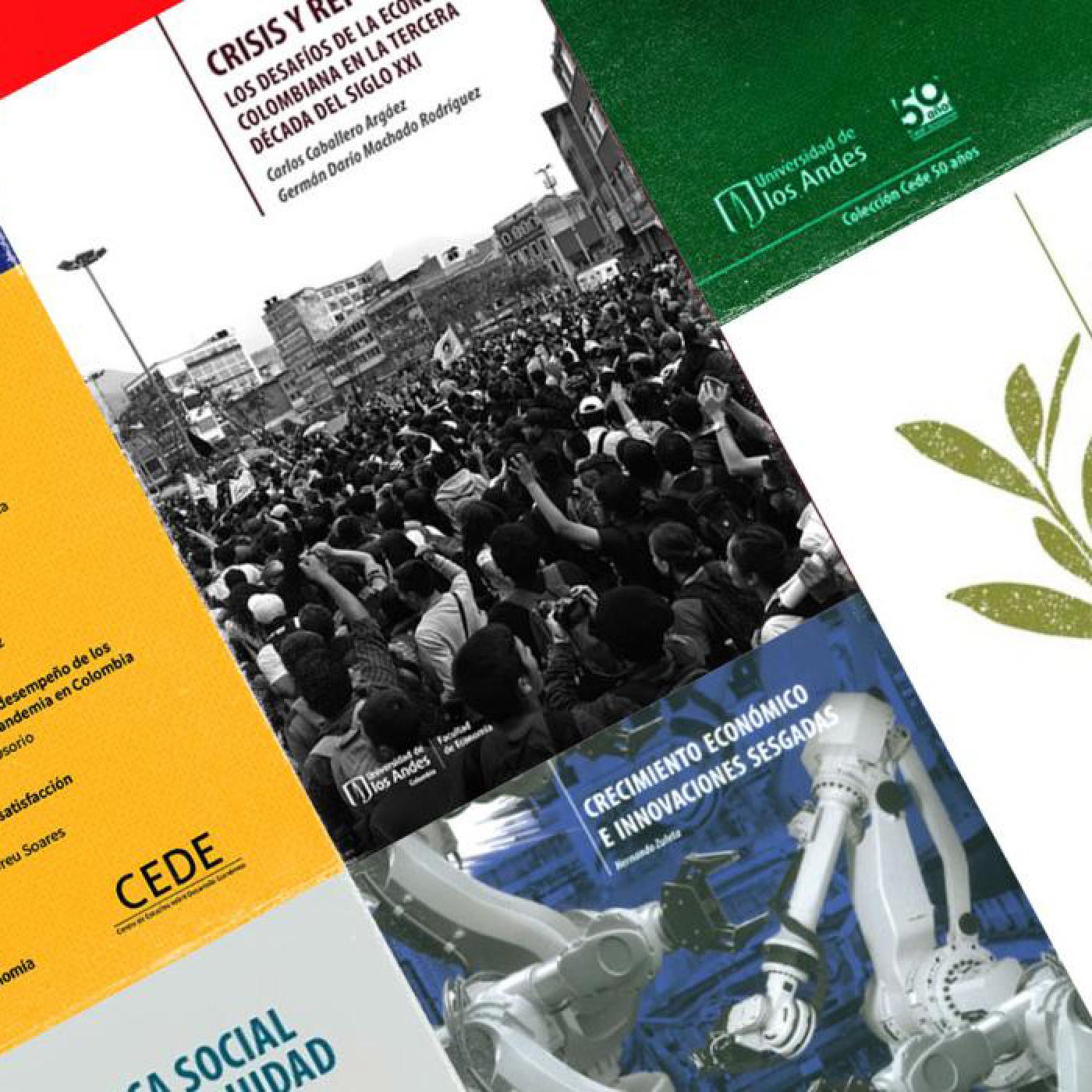
Documentos CEDE
Accede a las publicaciones que reúnen trabajos de profesores/as e investigadores/as de la Facultad de Economía, basados en información del Centro de Datos CEDE. Presentan análisis económicos y resultados preliminares que aportan evidencia y abren discusiones académicas sobre temas relevantes para el país.

Can emergency unconditional cash transfers (UCTs) protect educational investments and human capital accumulation during economic crises? While UCTs mitigate immediate economic hardship, evidence on their capacity to safeguard educational outcomes during emergencies remains limited. This study investigates Brazil’s Auxílio Emergencial program, one of the developing world’s largest emergency cash transfer programs, and its impact on educational attendance during the COVID-19 pandemic. Using household survey microdata and a regression discontinuity design that exploits exogenous variation in program eligibility, I estimate causal effects on educational attendance among demographic groups within vulnerable single-mother households. Eligibility increased attendance by 16.0 percentage points for young men aged 18–24, with effects driven primarily by those who had dropped out and re-engaged with secondary virtual education. The effects are concentrated among men and are not statistically significant for women. The mechanism operates by reducing economic pressure on households, enabling continued educational participation among younger members while preventing primary earners from engaging in low-quality or informal employment.
How does a sudden, large-scale inflow of migrants reshape the political attitudes of locals? This paper uses a shift-share design that exploits exogenous variation in arrivals to estimate the effects of Venezuelan migration on political attitudes in Colombia between 2013 and 2019. The results suggest that exposure to the migration shock reduces locals’ support for redistribution, shifts their political ideology to the right, and weakens their support for elections by popular vote. A mediation analysis suggests that negative stereotypes about migrants and other migration-related concerns, including perceived labor market competition, security concerns, and concerns about migrants’ overuse of welfare programs, contribute to explain the decrease in the support for redistribution by increasing in-group identification sentiments among locals. The decrease in the support for elections by popular vote appears to be consistent with locals having less confidence on elections due to doubts about whether elected rulers can ensure an adequate provision of welfare services and maintain public order after the massive migration shock. Finally, the propensity of locals to adhere to anti-left narratives is a key driver of these shifts in political attitudes, including the rightward shift in ideology, which highlights the importance of the associations between the left-wing ideology and the Venezuelan regime in this setting.
Do the returns to quality upgrading pass through supply chains to primary producers? We explore this question in the context of Colombia’s coffee sector, in which market outcomes depend on interactions between farmers, exporters (which operate mills), and international buyers, and contracts are for the most part not legally enforceable. We formalize the hypothesis that quality upgrading is subject to a key hold-up problem: producing high-quality beans requires long-term investments by farmers, but there is no guarantee that an exporter will pay a quality premium when the beans arrive at its mills. An international buyer with sufficient demand for highquality coffee can solve this problem by imposing a vertical restraint on the exporter, requiring the exporter to pay a quality premium to farmers. Combining internal records from two exporters, comprehensive administrative data, and the staggered rollout of a buyer-driven quality-upgrading program, we find empirical support for the key theoretical predictions, both the lack of pass-through of quality premia under normal circumstances and the possibility of a buyer-driven solution through a vertical restraint. Calibration of the model suggests that one-third to two-thirds of the (substantial) gains from the program accrue to farmers, with the vertical restraint playing a critical role. The results are consistent with the hypotheses that quality upgrading can provide a path to higher incomes for farmers, but also that it is unlikely to be viable under standard market conditions in the sector.
Countries at similar income levels exhibit markedly different rates and anatomies of labor informality. We organize these patterns around three interacting forces: a legal wedge (minimum wages and non-wage labor costs, alongside enforcement), the sectoral productivity and composition, and the private value of formality (coverage, portability, and contract enforceability). A parsimonious model yields sharp “thin-margin” predictions: effects concentrate where earnings cluster near the minimum legal standards. Evidence from a cross-country, country–sector panel supports the framework—legal and enforcement effects are largest where thin-margin exposure is high; higher private value lowers informality and dampens wedge effects; and composition, especially within services, conditions aggregates. The results reconcile disparate findings and imply targeted policy: align enforcement with thin-margin exposure, raise the private value of formality via low-friction administration and portability, and pursue sectoral paths that expand formal-leaning activities.