Pasar al contenido principal

Eventos pasados

Consulta en esta sección los eventos anteriores.

Imagen Seminario CEDE - Umberto Muratori
Activo

Seminario CEDE - Umberto Muratori

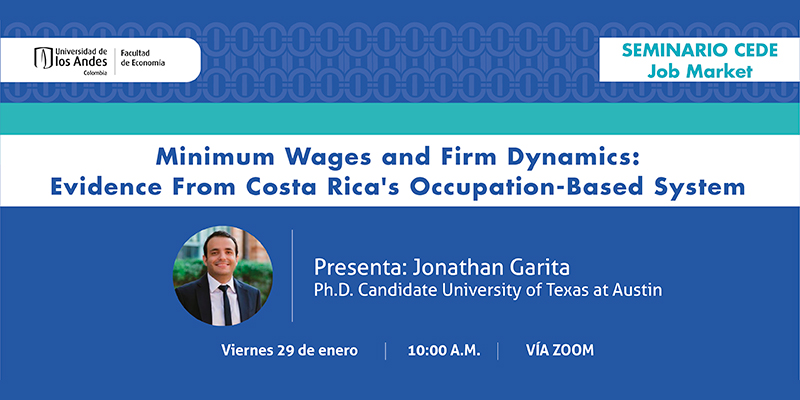
This paper investigates the differences in markups between and within cohorts of US firms. I document substantial between-cohort differences and a relatively flat profile over time within cohorts. The paper uses administrative patent data to provide suggestive evidence that knowledge creation and diffusion explain these patterns. Namely, the between-cohorts pattern is associated with improvements in the innovation quality, and the within-cohort pattern is the result between the interaction of innovation and knowledge diffusion. Motivated by this new empirical evidence, I develop a general equilibrium endogenous growth model of creative destruction augmented with knowledge diffusion. I build the model for two purposes. First, I estimate the changes in the intensity of knowledge diffusion. I find knowledge diffuses 38% faster in 2010 than it did in 1980. Second, I quantify the effect of changes in the innovation step size and intensity of knowledge diffusion on growth and welfare. The quantitative exercises show the consumption-equivalent welfare increases by 0.29% if the innovation step size and intensity of knowledge diffusion increase from their 1980 to their 2010 values. By contrast, the counterfactual experiments highlight the increase in these parameters has no substantial effect on growth. Changes in the innovation quality and the speed of knowledge spillover can be achieved by reforming the patent system, such as changing the non-obviousness requirements or the patent term. The findings suggest policymakers, who aim to maximize the welfare, should choose short patent terms and low innovative-step requirements. Ver documento  

10:00 am
Zoom
Imagen Seminario CEDE - Joana Duran-Franch
Activo

Seminario CEDE - Joana Duran-Franch

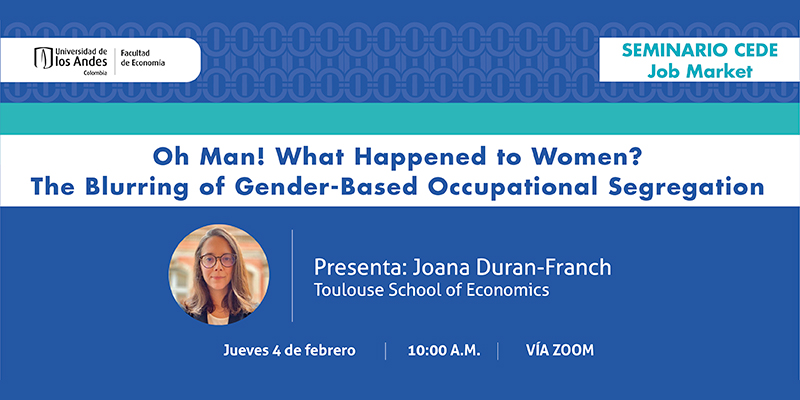
The participation of women in the U.S. labor market increased during the past century. However, progress stalled and since 2000 the employment rate of women has not progressed. These changes are driven by the least educated women who have decreased their employment rate. In parallel, potential employment opportunities for this demographic group have grown: Service and clerical occupations, traditional sources of employment for low-educated women, have experienced employment growth over this period. I show empirically that the decline of employment in blue-collar occupations helps reconcile these two facts: Low-educated men, employed in blue-collar occupations and now out of employment, entered services and clerical occupations; blurring the existing gender-based occupational segregation and crowding some low-educated women out. I establish a causal link between these changes using an IV strategy and exploiting the cross-section variation at the local labor market level. I formalize a static general equilibrium model where individuals, who are heterogeneous in gender, education level and skills, decide which occupation type to sort into. The model is able to replicate the labor reallocation observed in the data by gender and level of education. The model shows that demographic changes have masked the effect of the demanualization in the labor market. The demanualization, driven by labor-saving technology improvements in blue-collar occupations, has decreased the aggregate employment rate of low-educated women from 1990-2016 by 8.1 percentage points, the same magnitude by which it has affected men. For men, the aggregate effect is smaller than the direct one on blue-collar employment, since low-educated men have relocated to other occupations. For women, 51% of the aggregate change corresponds to the direct effect on blue-collar employment; 49%, to the indirect crowding-out effect.

10:00 am
Zoom
Imagen Seminario CEDE - Camila Galindo
Activo

Seminario CEDE - Camila Galindo

I study treatment effects under multiple options that lack a clear ranking. When the identifying variation stems from multiple instruments, agents can switch into different options and from many initial states. I discuss how to use conditional choice rules to estimate the shares of agents switching at well-defined margins of choice and their treatment effects. I develop an empirical strategy consistent with this framework and apply it to assess the impact of childcare choice in Colombia on children’s development. Parents can choose between home care and public care at small or large centers. I exploit two sources of exogenous variation: an experiment that provides information and encourages parents to switch to large centers, jointly with the geographical distance between the child’s home to the nearest center. Parental responses to the experimental variation can differ depending on the distance to the center. This feature uncovers heterogeneous responses along two margins of choice: small versus large centers, and small centers versus home care. Previous methods would attribute all the experimental variation to the small versus large centers margin. I find that, on average, 15-18% of parents are induced to switch from small towards large centers as the lottery outcome and proximity vary. My results suggest that, on average, switching towards large centers might benefit some children who live far from large centers but have more educated mothers.

10:00 am
Zoom