Pasar al contenido principal

Eventos pasados

Consulta en esta sección los eventos anteriores.

Imagen Seminario CEDE - Danilo Aristizabal
Activo

Seminario CEDE - Danilo Aristizabal

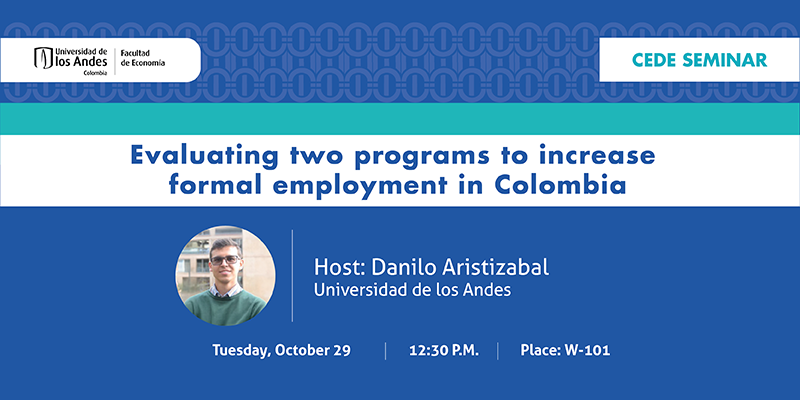
There is a close relationship between poverty and social and labor exclusion. I evaluated two ALMPs that targeted people who have difficulties in finding a formal job in a developing country. First, I analyze the effect of a training component of a labor intermediation policy (LIP) called Boost to Employment (BE) on the probability of finding a formal job for vulnerable job seekers in a developing country. I exploit the variation in the leniency among labor counselors as an instrument to approximate the probability that job seekers receive the training component. I also test which courses are the ones that helped job seekers to find formal jobs. I find that those workers who received the training component increased the probability of working in the formal sector by 21 percentage points one year after the implementation of the program compared to those workers who did not. The formal job benefits course seems to be driving my results. Second, I study the effect on labor market outcomes of a payroll tax cut for new hires of young workers under the age of 28 in an economy with a high binding minimum wage. I use exposure to wage rigidities to identify the effect. I measure an individual's exposure to wage rigidities as the gap between the median salary, in the city in which the individual lives, and the minimum wage set at the national level. I use a difference-in-difference model. I find that the effect of a payroll tax cut is asymmetric for youth who face labor markets with a binding minimum wage and those who do not.

12:30 pm
Universidad de los Andes
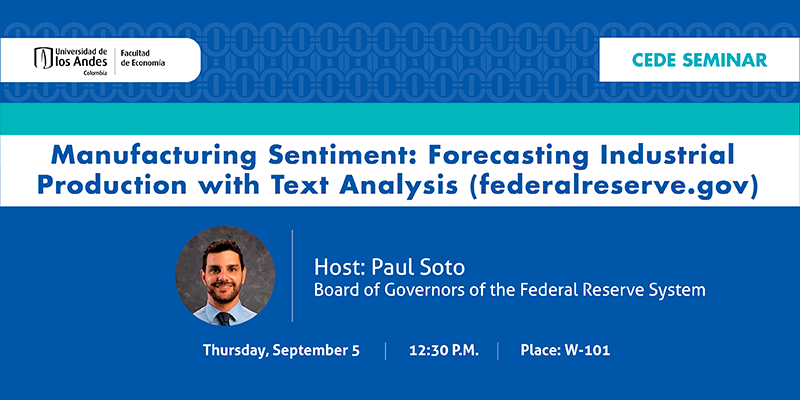
Imagen Seminario CEDE - Paul Soto
Activo

Seminario CEDE - Paul Soto

This paper examines the link between industrial production and the sentiment expressed in natural language survey responses from U.S. manufacturing firms. We compare several natural language processing (NLP) techniques for classifying sentiment, ranging from dictionary-based methods to modern deep learning methods. Using a manually labeled sample as ground truth, we find that deep learning models--partially trained on a human-labeled sample of our data--outperform other methods for classifying the sentiment of survey responses. Further, we capitalize on the panel nature of the data to train models which predict firm-level production using lagged firm-level text. This allows us to leverage a large sample of "naturally occurring" labels with no manual input. We then assess the extent to which each sentiment measure, aggregated to monthly time series, can serve as a useful statistical indicator and forecast industrial production. Our results suggest that the text responses provide information beyond the available numerical data from the same survey and improve out-of-sample forecasting; deep learning methods and the use of naturally occurring labels seem especially useful for forecasting. We also explore what drives the predictions made by the deep learning models, and find that a relatively small number of words--associated with very positive/negative sentiment--account for much of the variation in the aggregate sentiment index.  

12:30 pm
Universidad de los Andes
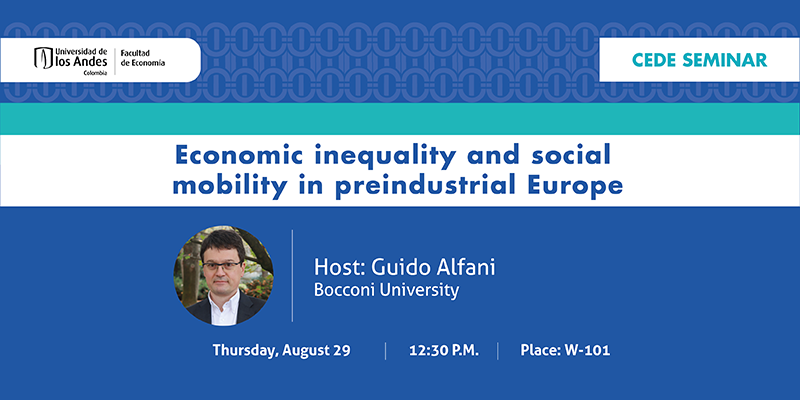
Imagen Seminario CEDE - Guido Alfani
Activo

Seminario CEDE - Guido Alfani

Recent research in economic history has unearthed previously unknown facts about the long-term trends in inequality. We now have, for at least some areas of Europe, continuous time series of key inequality indicators from ca. 1300. Most of these series have resulted from the research conducted by the ERC-funded project EINITE – Economic Inequality across Italy and Europe 1300-1800 and by its follow-up project, SMITE – Social Mobility and Inequality across Italy and Europe 1300-1800. These new data are changing the way in which we perceive economic inequality not only in the past, but even today – as a key lesson from history, is that economic inequality (especially, but not only, of wealth) has a marked tendency for increasing over time, and only catastrophes on the scale of the Black Death or the World Wars managed to bring it down, albeit temporarily. Additionally, the new historical evidence is also relevant to the debate about the long-term determinants of inequality growth. This seems to be independent, to a large degree at least, from economic growth. Other factors seem to have played a crucial role, including institutional factors and in particular (in the early modern period) the rise of the fiscal-military state. The seminar will provide an overview of recent research on inequality in preindustrial Europe, with a particular focus on some areas on which research is currently ongoing, in particular the southern Italian regions of Apulia and Sicily.
12:30 pm
Universidad de los Andes
Imagen Seminario CEDE - Diego Ramos
Activo

Seminario CEDE - Diego Ramos

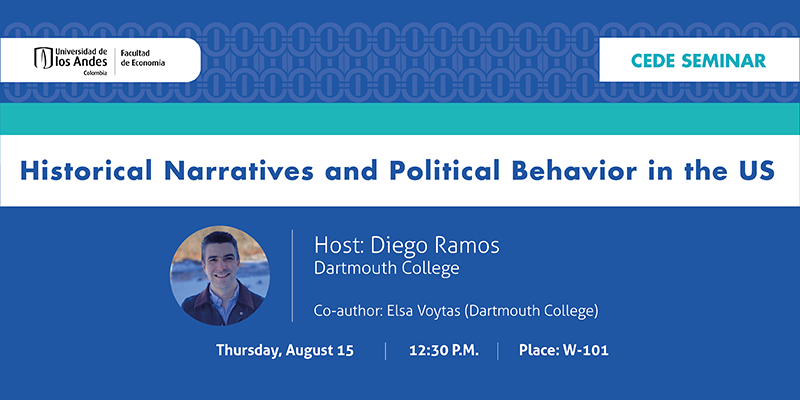
We examine perceptions of the history of race in the United States and its impact on present-day political polarization. Based on survey data from 14,044 US respondents, we examine historical narratives surrounding key racial events among both white and Black individuals. Our analysis unveils notable discrepancies in beliefs regarding the causes of the Civil War, the achievements of the Civil Rights Movement, and the enduring legacy of slavery on Black Americans today. Ideological divisions in historical interpretations, particularly among white respondents, emerge prominently, while differences across race and generation are less pronounced. Moreover, we investigate the political ramifications of these historical viewpoints through two experimental interventions. Participants were randomly prompted to contemplate their own perspectives on these issues and to confront the views of others. The results of our experiments indicate that historical narratives about race can exacerbate polarization in institutional satisfaction. Liberals exhibit heightened pessimism and dissatisfaction with the current institutional framework as a result of the treatments, while conservatives remain largely unaffected. This study underscores the significance of understanding the origins and repercussions of historical accounts concerning intergroup tensions, which may contribute to contemporary political divisions.

12:30 pm
Universidad de los Andes