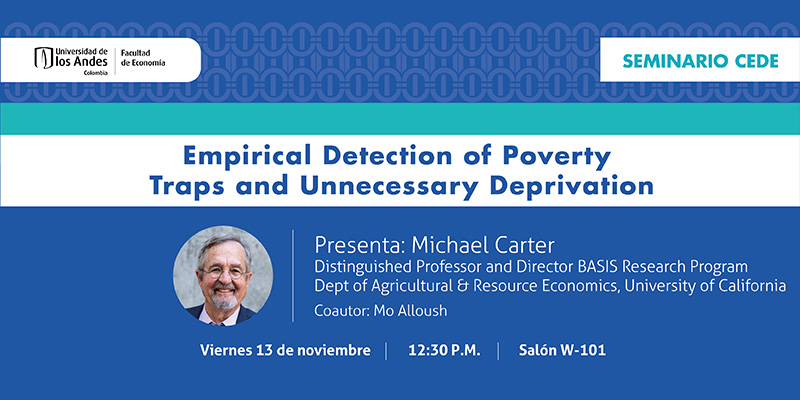
Seminario CEDE - Michael Carter
Michael Carter.
A poverty trap exists when individuals are in equilibrium at a poor standard of living, and will not of their own volition escape poverty. Dynamic models of asset accumulation and occupational choice can create two types of poverty traps: conditional convergence poverty traps and unnecessary deprivation poverty traps. While distinguishing between these two types of chronic poverty is vital from a policy perspective, we show that existing empirical methods of detecting poverty traps are at best able to identify if multiple equilibria exist, but they are unable to distinguish between the two types of traps. In this paper, we fill this lacunae by proposing a shocks-based approach to detect poverty traps that distinguishes between conditional convergence and unnecessary deprivation traps. To illustrate the properties of ours and other approaches to test for poverty traps, we use a dynamic stochastic programming model to create simulated longitudinal data on households and their living standards. By manipulating the underlying parameters of the model, we create distinctive data generation processes characterized by no poverty traps, only one type of trap, or both types of traps coexisting in equilibrium. These different processes in turn allow us to reveal the strengths and weaknesses of different approaches. We then apply our proposed approach to real-world data.